About Pellaea atropurpurea (L.) Link
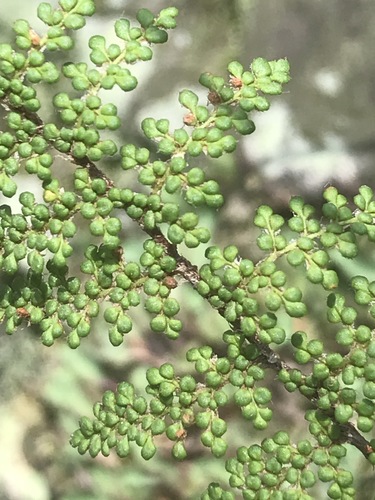
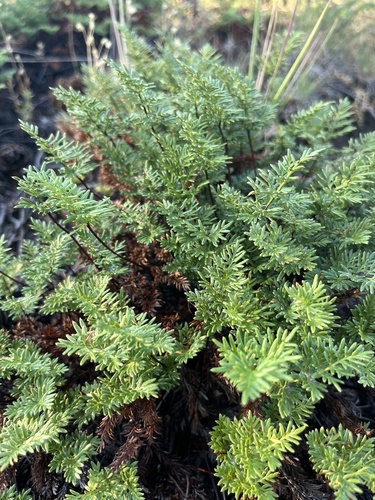
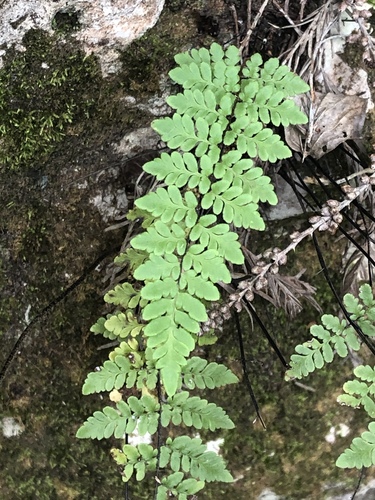
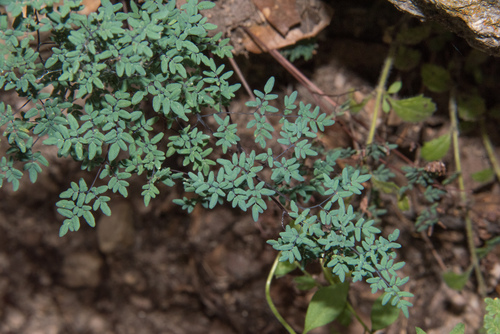
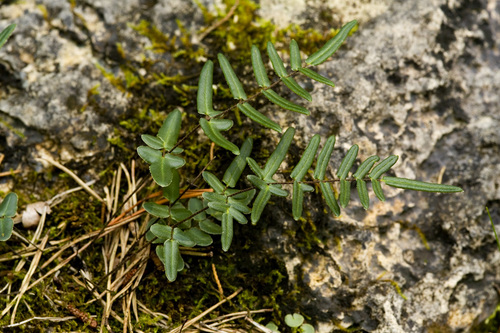
This fern species grows in clumps made up of widely arching fronds. Its stipe and blade rachis are purple, and the blade itself has a blue-gray tint. Upper pinnae are long, narrow, and undivided, while lower pinnae are split into 3–15 pinnules. Most pinnae are arranged oppositely. Fertile fronds are longer and more deeply divided, and produce sori that lack a true indusium inside the inrolled margins of the pinnae. It can be told apart from the closely similar species Pellaea glabella by its larger size and the presence of hairs on the leaf axis, the main leaf stem, and on the undersides of leaflet midribs; these hairs are not present in Pellaea glabella, a feature referenced in that species’ common name smooth cliffbrake. In ecological terms, Pellaea atropurpurea grows in crevices of dry limestone cliffs, on rocky slopes, in alvar crevices, and on mortared walls. It is classified as endangered in Florida, Iowa, and Rhode Island. It is now extinct in Louisiana, after the limestone caprock of a salt dome at Winfield, the only location this fern grew in the state, was removed by quarrying.