About Pelidnota punctata (Linnaeus, 1758)
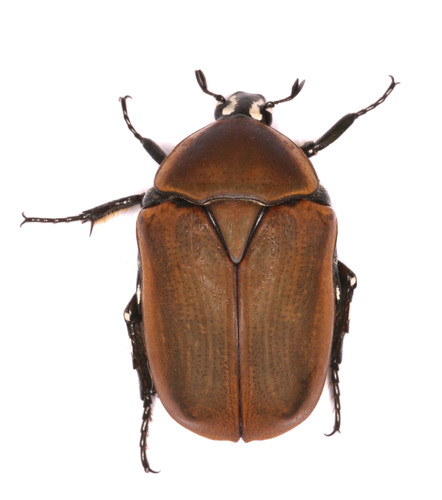
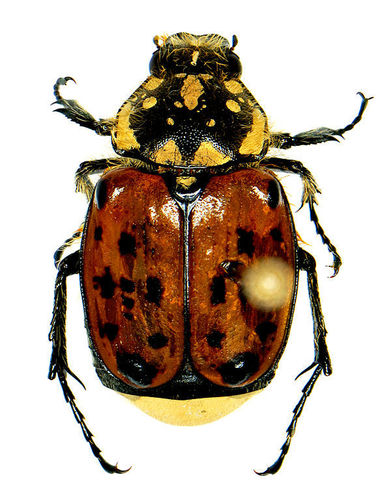
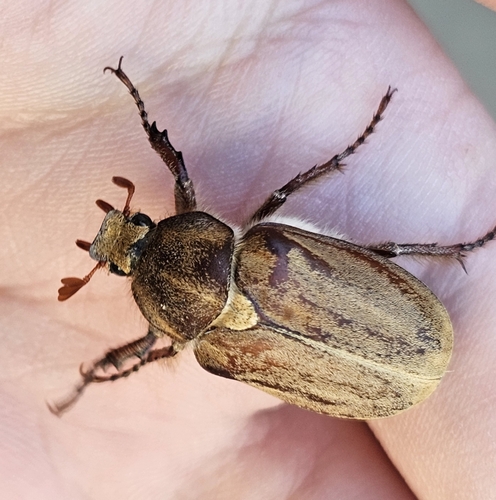
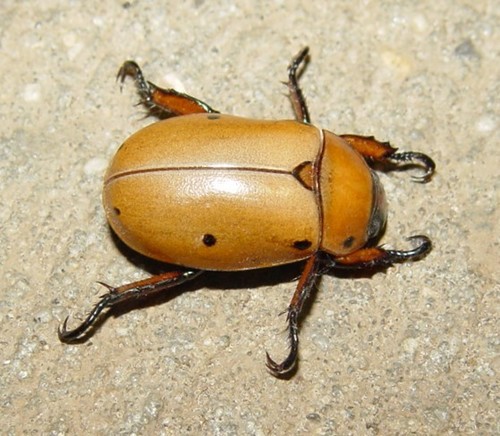
Pelidnota punctata, commonly known as the grapevine beetle, spotted June beetle, or spotted pelidnota, is a species of scarab beetle belonging to the family Scarabaeidae and subfamily Rutelinae. This species is common in north and central United States and eastern Canada, and causes relatively little damage to its host plants. Grapevine beetles fly quickly, usually along a curving path. Adult grapevine beetles are approximately 2.5 centimetres (1 inch) long, and may occasionally reach 3 cm (1.2 in) in length. Their base color is off-yellow or auburn red, with four black spots running down each side of the body. Fine black lines run along the edges of the beetle's elytra. Pelidnota punctata has distinct regional variants: the common southern form lacks darker leg coloration, while the northern form has darker legs. Adult beetles from the northern portions of the species' range have darker and more spots, while beetles from southern regions may have no spots at all. This is a morphologically variable species, and its taxonomy was confused when author Thomas Casey split the species into 11 separate taxa in 1915; later researchers later placed all of these 11 names into synonymy. This species is distributed across the eastern portion of North America, ranging from Ontario and Maine in the north to Florida in the south, and westward to Texas and South Dakota. Like many beetles, it inhabits forests, thickets, and woods, and is most often seen during the summer. It is an active flyer, and individuals are commonly attracted to lights at night. It can also be found in vineyards and gardens. Adult grapevine beetles feed on the leaves and fruit of both wild and cultivated grapevines, though they are not typically a major pest of commercial vineyards. Females lay eggs in rotten wood, tree stumps, or on soil near the beetle's host plant. Eggs hatch into larvae that may grow up to two inches long. After hatching, larvae dig into the soil, where they feed on rotted wood. Pupal chambers are built shallowly underground. Adults emerge from the chambers in July, and the species' full life cycle lasts two years.