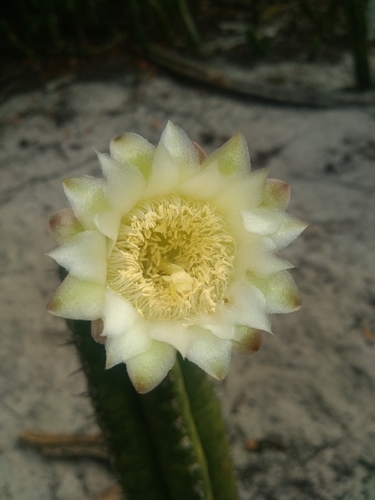
About Pelecyphora sneedii subsp. orcuttii (Boed.) D.Aquino & Dan.Sanchez
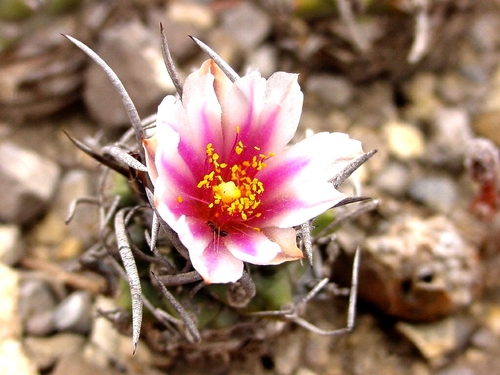
Pelecyphora sneedii subsp. orcuttii, commonly known as Sneed's pincushion cactus, is a small cactus. Mature specimens grow up to around 27 centimetres (11 inches) tall, but often only a few centimeters of the stem are visible above ground, with the remainder buried underground. This species can branch heavily even when small and immature, and some populations form up to 250 branches per individual. The entire stem is densely covered in areoles that bear bright white spines, with up to nearly 100 spines per areole. Each areole holds 25 to 52 radial spines, which are more or less tightly appressed against the stem and measure 3–14 mm (0.12–0.55 in) long. Each areole also has 8 to 17 outer central spines, which range from appressed to strongly projecting from the stem. There are up to 5 inner central spines per areole; these are typically straight and arranged in a radiating, spoke-like pattern, and measure 3–25 mm (0.12–0.98 in) long. Spine color can have yellow, pink, purple, or brown tints depending on the growing substrate, and spines often have dark tips. As the cactus ages, its spines darken to gray and eventually black. P. sneedii typically blooms in spring, from March to June. Flowers grow 1–3 cm (0.39–1.18 in) long and 7–25 mm (0.28–0.98 in) wide, and form near the apical (top) part of the stem. Outer tepals have sparse to dense fringes along their margins. There are 11 to 26 inner tepals, which can be white, cream, pale tan, greenish white, or pale rose-pink. Tepals usually have clearly defined darker midstripes of varying colors, though these stripes are sometimes absent. Inner tepals measure 5–14 mm (0.20–0.55 in) long by 0.8–4 mm (0.031–0.157 in) wide. Stamen filaments are low-contrast, often matching the color of the tepals, and are topped with sulphur yellow or canary yellow anthers. The stigma is split into 2 to 7 pale lobes that measure 1–3 mm (0.039–0.118 in) long. Fruits develop from May to September, and are dimorphic with two distinct color phases: a red phase ranging from blood-red to magenta, and a green phase ranging from greenish-yellow to brown or purple. Fruits are shaped cylindric, fusiform, obovoid, or narrowly clavate, and grow up to 21 millimetres (0.83 in) long. The dried remains of the flower persist on the mature fruit, and the originally juicy, succulent fruit dries out quickly once mature. Seeds are brownish, 1.6 millimetres (0.063 in) long, and have a distinctive pitted surface. This subspecies is native to the Chihuahuan Desert, where it grows in scattered locations across New Mexico, Texas, and Chihuahua. Some plants found in Arizona may also be classified as this subspecies. It most commonly grows in broken rocky terrain and steep slopes made of Silurian-Ordovician-Cambrian limestone, typically within Chihuahuan desert scrub habitat; it also sometimes grows in coniferous woodlands in the Trans-Pecos region. Sneed's pincushion cactus is popular among cactus enthusiasts and commercial dealers, due to its generally small size and tolerance of moderately cold climates. For successful cultivation, it requires a well-draining inorganic substrate, because its roots rot easily if kept too wet. The cactus must be kept completely dry during its winter dormant season, and atmospheric humidity must be kept low. Regular watering can be done through spring and summer once the growing season begins, as long as the growing medium is well-drained. Fertilization is simple: only a high-potassium fertilizer is needed during the summer growing season. Propagating from seed is straightforward: seeds sown after the last frost in spring typically germinate within one to two weeks when kept well-ventilated and out of direct sunlight. Sneed's pincushion cactus can also be propagated asexually from offsets that grow at the base of the plant.