About Pekania pennanti (Erxleben, 1777)
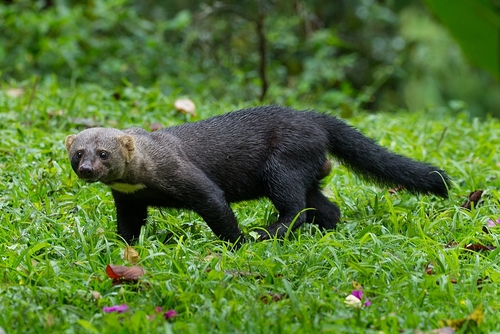
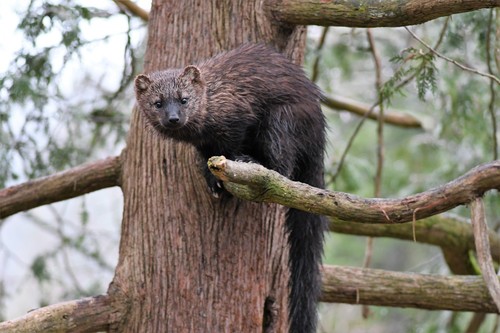
Pekania pennanti, commonly called fishers, have long, thin bodies that are held low to the ground. While males and females share similar physical features, they are sexually dimorphic in size, with males being much larger. Males measure 90–120 cm (35–47 in) in total length and weigh 3.5–6.0 kg (8–13 lb). Females measure 75–95 cm (30–37 in) and weigh 2.0–2.5 kg (4–6 lb). Head and body length for both sexes ranges from 47–75 cm (19–30 in), and the tail adds an additional 30–42 cm (12–17 in). The largest recorded male fisher weighed 9 kg (20 lb). A fisher’s fur changes with the season and differs slightly between sexes: males have coarser coats than females. In early winter, coats are dense and glossy, with fur length ranging from 30 mm (1 in) on the chest to 70 mm (3 in) on the back. Fur color ranges from deep brown to black, and appears much blacker in winter when contrasted against white snow. Fur from the face to the shoulders may be hoary-gold or silver, due to tricolored guard hairs. A fisher’s underside is almost entirely brown except for randomly placed patches of white or cream-colored fur. In summer, fur color is more variable and may lighten considerably. Fishers moult starting in late summer, finishing by November or December. Fishers have five toes on each foot, with unsheathed, retractable claws. Their large feet make it easier for them to move across snow packs. Each foot has four central pads in addition to the toes. Coarse hairs grow between the pads and toes on hind paws, providing added traction on slippery surfaces. Fishers have highly mobile ankle joints that can rotate their hind paws almost 180°, letting them maneuver well in trees and climb down head-first; the fisher is one of the few mammal species that can descend trees head-first. A circular hair patch on the central pad of hind paws marks plantar glands that produce a distinctive odor. These patches enlarge during breeding season, so they are likely used to create scent trails that help fishers find each other to mate. Fishers are generally crepuscular, most active at dawn and dusk, and active year-round. They are solitary, only associating with other fishers to mate. Males become more active during the mating season. Females are least active during pregnancy, and gradually increase activity after giving birth to their kits. A fisher’s hunting range varies from 6.6 km2 (3 sq mi) in summer to 14.1 km2 (5 sq mi) in winter; ranges up to 20.0 km2 (8 sq mi) are possible in winter depending on habitat quality. Male and female fishers have overlapping territories. This pattern is imposed on females by males, due to males’ size dominance and their drive to increase mating success. Although fishers are skilled tree climbers, they spend most of their time on the forest floor and prefer continuous forest over other habitats. They have been found in extensive conifer forests typical of boreal regions, and are also common in mixed hardwood-conifer forests. Fishers prefer areas with continuous overhead cover of more than 80%, and avoid areas with less than 50% cover. They are more commonly found in old-growth forests. Because female fishers need moderately large trees for denning, heavily logged forests with extensive second growth are generally unsuitable for their needs. Fishers also select forest floors with large amounts of coarse woody debris. In western forests where fire regularly removes understory debris, fishers prefer riparian woodland habitat. They tend to avoid areas with deep snow, and their habitat is also affected by snow compaction and moisture content. Fishers are widespread across the northern forests of North America, occurring in a belt of boreal and mixed deciduous-coniferous forest that stretches across Canada from Nova Scotia in the east to the Pacific shore of British Columbia, and north to Alaska. They range as far north as Great Slave Lake in the Northwest Territories and as far south as the mountains of Oregon. Isolated populations live in California’s Sierra Nevada, throughout New England, New York’s Catskill Mountains, and the Appalachian Mountains of Pennsylvania, Maryland, West Virginia, and Virginia. In the late 19th and early 20th centuries, fishers were nearly eliminated from the southern and eastern parts of their range, including most American states and eastern Canada including Nova Scotia. Overtrapping and forest habitat loss caused the decline. Most states had implemented restrictions on fisher trapping by the 1930s, which coincided with the end of the logging boom. A combination of forest regrowth on abandoned farmlands and improved forest management increased available habitat and allowed remnant populations to recover. Populations have since recovered enough that the species is no longer endangered, and increasing forest cover in eastern North America means fisher populations will remain sufficiently robust for the near future. Between 1955 and 1985, some states allowed limited trapping to resume. In areas where fishers were eliminated, porcupine populations grew, and high porcupine densities caused extensive damage to timber crops. In these cases, fishers were reintroduced by releasing adults relocated from other areas into the forest. Once fisher populations became re-established, porcupine numbers returned to natural levels. In Washington, fisher sightings were reported into the 1980s, but an extensive 1990s survey found none. Scattered fisher populations now exist in the Pacific Northwest. In 1961, fishers from British Columbia and Minnesota were reintroduced in Oregon to the southern Cascades near Klamath Falls and to the Wallowa Mountains near La Grande. From 1977 to 1980, fishers were introduced to the region around Crater Lake. Starting in January 2008, fishers were reintroduced to Washington State. The initial reintroduction was on the Olympic peninsula with 90 animals, with subsequent reintroductions to the south Cascade Mountains. The reintroduced animals are monitored by radio collars and remote cameras, and have been confirmed to be reproducing. From 2008 to 2011, around 40 fishers were reintroduced in the northern Sierra Nevada near Stirling City, adding to existing fisher populations in Yosemite National Park and along California’s northern border between the Pacific Coast Ranges and the Klamath Mountains. Fishers are a protected species in Oregon, Washington, and Wyoming. In Idaho and California, fishers are protected through a closed trapping season but do not receive specific protection; however, the fisher has been granted threatened status under the Endangered Species Act in California. In June 2011, the U.S. Fish and Wildlife Service recommended removing fishers from the endangered list in Idaho, Montana, and Wyoming. Recent studies and anecdotal evidence show fishers have begun moving into suburban backyards, farmland, and periurban areas in several US states and eastern Canada, as far south as most of northern Massachusetts, New York, Connecticut, Minnesota, Iowa, and even northwestern New Jersey. After virtually disappearing following construction of the Cape Cod Canal in the early 1900s, some reports show populations have re-established on Cape Cod, though these populations are likely smaller than those in western New England. Female fishers begin breeding at around one year of age, and their reproductive cycle takes almost a full year. Mating occurs from late March to early April. Blastocyst implantation is delayed for ten months, until mid-February of the following year when active pregnancy begins. After a 50-day gestation period, females give birth to one to four kits. Females enter estrus 7–10 days after giving birth, and the breeding cycle starts again. Females den in hollow trees. Kits are born blind, helpless, and partially covered in fine hair. They begin crawling after around three weeks, open their eyes after around seven weeks, and start climbing after eight weeks. Kits are completely dependent on their mother’s milk for the first eight to ten weeks, after which they switch to a solid diet. After four months, kits become intolerant of their litter mates, and at five months the mother pushes them out to live on their own. Juveniles establish their own home ranges after one year. In 2012, a study conducted by the Integral Ecology Research Center, UC Davis, U.S. Forest Service, and the Hoopa tribe found that fishers in California were exposed to and killed by anticoagulant rodenticides associated with marijuana cultivation. In this study, 79% of tested California fishers were exposed to an average of 1.61 different anticoagulant rodenticides, and four fishers died from this exposure. A 2015 follow-up study built on these data found that the rate of exposure and mortality from these toxicants had risen to 85%, California fishers were now exposed to an average of 1.73 different anticoagulant rodenticides, and 9 more fishers had died, bringing the total to 13. A 2013 study focusing on fisher survival and impacts from marijuana cultivation in the Sierra National Forest highlighted the extent of marijuana cultivation within fishers’ home ranges. On average, fishers had 5.3 individual marijuana grow sites within their home range, and one fisher had 16 individual grow sites within its territory.