About Pediocactus simpsonii (Engelm.) Britton & Rose
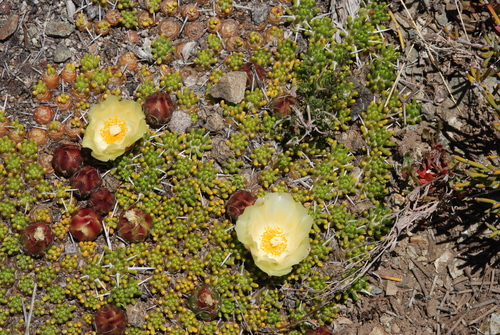
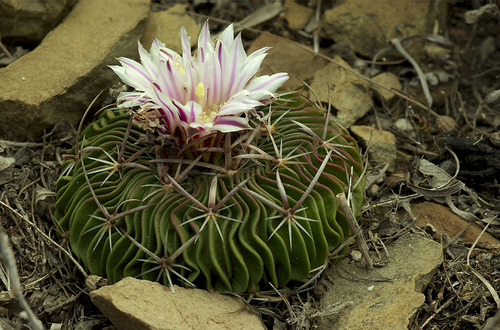
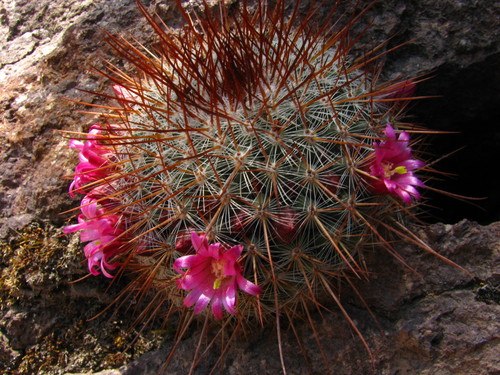
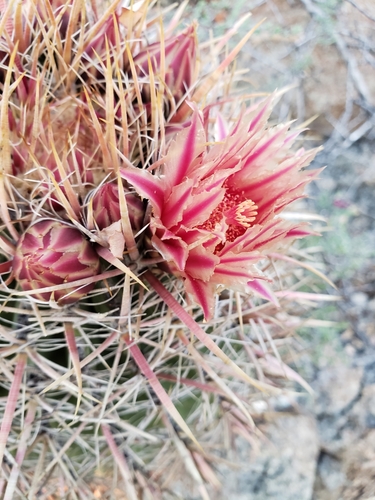
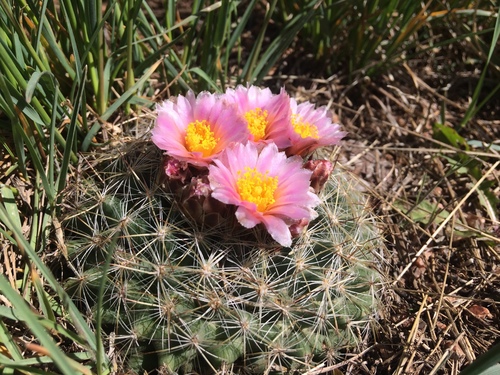
Pediocactus simpsonii (Engelm.) Britton & Rose is a succulent cactus that grows one or more enlarged rounded stems, which measure 2.5 to 15 centimeters wide and 2.5 to 25 centimeters tall, and are typically less than 15 centimeters high. Stems are either ovoid (egg-shaped, wider toward the soil) or globose (ball-shaped), and may appear flattened or sunken into the ground, especially during winter. The plant's surface is covered in pyramid-shaped projections called tubercles. At the tip of each tubercle is a round to oval areole, 3 millimeters across. Areoles are covered in fine hairs (villous), and produce clusters of spines. The spines are hard, smooth, and differ in color and size based on their position in the cluster. Central spines number 4 to 11 per cluster, are 5 to 21 millimeters long, and have dark reddish-brown to black tips and cream to yellow bases. Radial spines, which grow around the center of the cluster, number 12 to 35 per cluster, are 3 to 13 millimeters long, and are white. This species is distributed across the interior western United States, ranging from Arizona and New Mexico in the south to Idaho and Montana in the north, and also occurs in Nevada, Utah, Wyoming, Colorado, and South Dakota. In Montana, it is only found in southwestern mountains near the Idaho border. It occurs across most of southern, non-panhandle Idaho, excluding only the western edge. In Wyoming, it grows in the southern and western parts of the state. In Nevada, it is found in mountain ranges of the Great Basin in eastern Nevada. In Utah, it occurs across most of the state where suitable habitat exists. In Colorado, it grows in the foothills, mountains, and west slope of the state. It only occurs in a small number of isolated populations in northern Arizona, and is restricted to the mountains of northern New Mexico. In 2013, NatureServe evaluated this species as globally secure (G5). At the state level, it is rated apparently secure (S4) in Montana, Nevada, and Utah; vulnerable (S3) in Idaho, New Mexico, and Wyoming; and critically imperiled (S1) in Arizona. NatureServe has not evaluated its status in Colorado or South Dakota. The largest threat to Pediocactus simpsonii is collection by gardeners and for the plant trade. In some areas, it is also threatened by mining or development. As many common names suggest, Pediocactus simpsonii grows mainly in mountains and other uplands, where it inhabits dry ground and slopes. It is associated with ponderosa pine forests, pinyon-juniper woodlands, cool sagebrush steppes, scrub oak undergrowth, and shortgrass prairie. It also grows on bare rock outcrops, including granite outcrops in Wyoming and sandstone outcrops in Colorado. It is a very hardy cactus; one mountain valley where it grows successfully has recorded a low temperature of -47 °C. Its elevation range is 1400 to 3500 meters, and in New Mexico it is very rarely found below 1800 meters. It grows at higher elevations than any other cactus native to North America. Annual precipitation in its habitat averages 25 to 30 centimeters, and can reach up to 50 centimeters. It remains unclear whether wildfires extirpate this species; it has been observed colonizing a small number of plots after low or medium intensity wildfires, but was found absent from another plot after a medium intensity fire. On the plains of Colorado, seeds of P. simpsonii have an elaiosome, and are thought to be dispersed by ants. Botanical texts note that Pediocactus simpsonii produces beautiful flowers, so it is sought after by gardeners for cold-climate rock gardens. When cultivated, it requires loose soil that does not harden excessively when dry. It grows well in a growing medium that is two-thirds sand and one-third rotted leaves, with a layer of pure sand around the plant base. Rot can develop if water accumulates around the plant. Flowering is reduced if the plant is not kept dry and cool during winter. Though very cold-hardy, it will die if transplanted to a hot desert climate. Germination studies show that seeds require cold-moist stratification for good germination. Only 10% of seeds germinated at 21 °C over eight weeks, while 67% germinated at 4.5 °C within 17 days. Further testing found that the growth hormone gibberellic acid (GA3) stimulated 70% germination in seeds stored for several months planted at 21 °C; even seeds stored for approximately two years had a 33% germination rate when treated with GA3. By contrast, seeds stored for several months, planted at 4.5 °C then moved to 21 °C, only had an 18% germination rate over 2 to 10 weeks.