About Pediocactus bradyi L.D.Benson
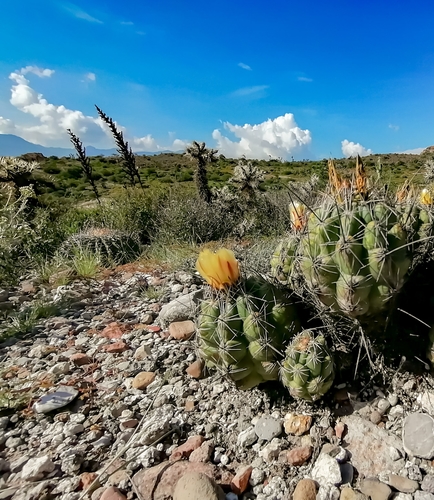
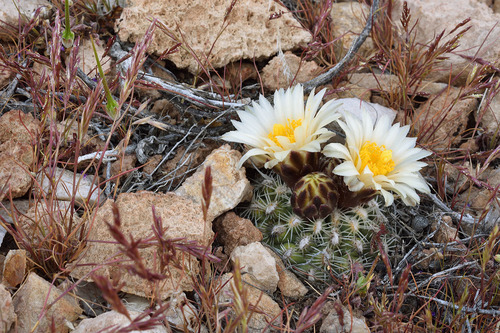
This species of cactus, Pediocactus bradyi L.D.Benson, is globose, covered in tubercles, and usually grows as a single individual. Mature specimens reach up to approximately 6 centimeters tall and 5 centimeters wide. Each areole bears some wool and several slightly curved spines that range in color from yellowish to white, growing up to half a centimeter long. Occasional individuals have one or two darker central spines. The species blooms in early spring. Open flowers measure up to around 2 centimeters long and 3 centimeters wide, with yellowish outer tepals marked by red or green stripes, and straw-colored inner tepals. Fruits are green when young, ripening to red-brown, and are about one centimeter long. During the dry season, this cactus shrinks and retracts underground, making it extremely difficult to locate. Two related taxa, Pediocactus bradyi subsp. winkleri and Pediocactus bradyi subsp. despainii, are currently classified as subspecies of this species. Pediocactus bradyi is native only to Coconino County, Arizona. It grows best on level hills covered in limestone gravel, at elevations between 900 and 1300 meters. It occurs on sandstone and shale terrain from the Moenkopi Formation geologic formation. This bedrock is covered in chips and gravel of Kaibab limestone, which forms the only substrate this cactus is found in; it does not grow in any other soil types. It is commonly found growing alongside shadscale (Atriplex confertifolia), snakeweed (Gutierrezia sarothrae), and Mormon tea (Ephedra viridis). Associated cactus and succulent species include Sclerocactus parviflorus, Navajoa peeblesiana subsp. fickeiseniorum, Echinocactus polycephalus var. xeranthemoides, Echinocereus engelmannii var. variegatus, Opuntia nicholii, Opuntia basilaris, and multiple Yucca species. This cactus is listed as an endangered species. It faces a number of threats, including highway construction and maintenance, off-road vehicle use, cattle grazing, and poaching. Natural threats to the species include frost heaving. Its small total population and limited geographic range leave it vulnerable to extinction, and it is also vulnerable to the effects of climate change, particularly increased drought frequency and severity.