About Pedicularis palustris L.
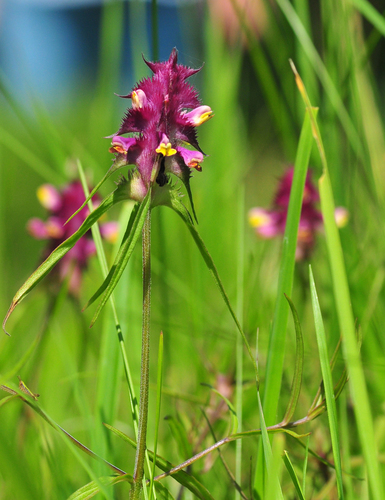
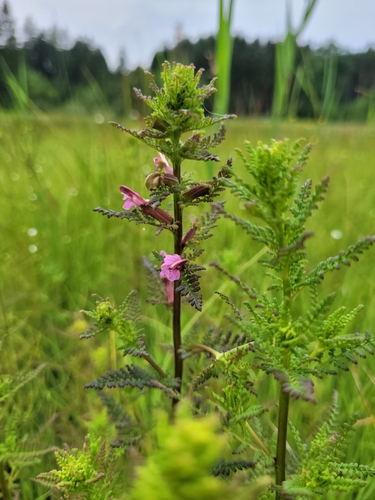
Pedicularis palustris L., commonly known as marsh lousewort, has two recognized subspecies that occupy different parts of its overall range. The nominate subspecies, Pedicularis palustris subsp. palustris, grows in the western portion of the species' range. It is a straggly biennial with a much-branched, usually erect stem that reaches up to 60 cm (24 in) tall. Its leaves grow alternately or oppositely, and each has a short stalk. Leaf blades range from triangular-lanceolate to linear, with pinnate lobes and toothed margins. Its inflorescence is a raceme that bears leaf-like bracts. Each bilaterally symmetrical flower has a short stalk and a large, rounded, toothed calyx. The flower is reddish-purple, grows up to 2.5 cm (1 in) long, and has five petals fused into a tube; the upper petal lip is slightly shorter than the lower lip. The fruit of this subspecies is a capsule. The second subspecies, Pedicularis palustris subsp. karoi, occurs in the eastern portion of the species' range; it is an annual plant and produces smaller flowers. This species can be told apart from the related common lousewort (Pedicularis sylvatica) by several key traits: it has two calyx lobes instead of four, and four small teeth at the tip of the upper petal lip instead of two. It is also taller and more erect than common lousewort, and grows in wetter locations. Marsh lousewort is distributed across central and northern Europe and Asia. In Europe, it is found in Scandinavia and extends southwards through most of the continent, growing at altitudes up to 1,200 m (4,000 ft). In the British Isles, it occurs mostly in Scotland, Ireland, Wales, western England, and East Anglia. In Asia, its range includes Russia, Kazakhstan, Mongolia, and northern China. Its typical habitat consists of wetland environments, including swamps, fens, marshes, wet meadows, and ditches. Ecologically, marsh lousewort is a semi-parasitic plant: its roots suck nourishment from neighboring plants. Its flowers are pollinated by honey bees and bumblebees. The pollinators land on the flower's lower lip, which droops under their weight. This allows the bees to thrust their heads inside the flower to extract nectar, and pollen becomes dusted on their bodies in the process.