About Pedicularis hirsuta L.
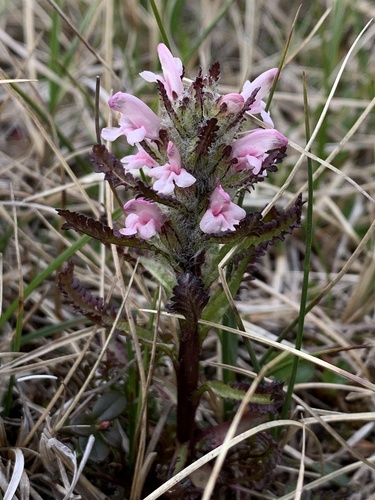
Pedicularis hirsuta L. is a low, solitary herb that grows from a taproot. It produces one or more rosettes of hairy, linear leaves that are borne on long petioles. These leaves are shallowly pinnately-lobed, sheathed at the base, and reach up to 5 cm (2 in) in length. From each rosette, one or more erect flowering stems grow, reaching a maximum height of 10 cm (4 in). Flowers grow in an alternating arrangement with long, pinnately-lobed bracts. The calyx is toothed, tubular, and fused. The corolla is partially tubular, two-lipped, and covered in long, floccose hairs. The upper lip of the corolla is hooded, while the lower lip has three distinct lobes. The fruit of this species is a single-chambered capsule that holds many small brown seeds. This plant occurs on tundra in subarctic regions of North America and Europe, and extends south along mountains in northern Europe into the boreal zone. Pedicularis hirsuta grows in well-vegetated herb-mats and heaths, in both fairly dry and fairly moist conditions, and tolerates various soil types, though it tends to avoid extremely acid sites. Due to its semi-parasitic nature, it is rarely found in sparsely vegetated habitats. When bumblebees are present, they may pollinate this species' flowers. On Svalbard, pollination is mostly done by flies, and self-pollination also occurs. The fruits have stiff stems and open at the apex, which supports ballistic seed dispersal. This plant does not appear to be significantly grazed by geese or reindeer.