About Pediasia aridella Thunberg, 1788
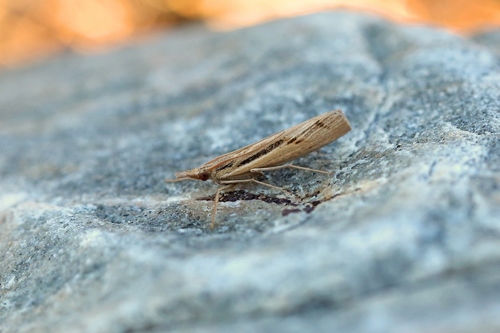
Pediasia aridella is a species of moth in the family Crambidae. It was first described by Carl Peter Thunberg in 1788, and can be found in Europe. Three subspecies of this moth are currently recognized. Its wingspan measures 20–26 mm. The moth's forewings are ochreous, with veins that vary in shade from pale to whitish; the spaces between veins are sometimes sprinkled with blackish coloring. A blackish streak runs beneath the median vein, extending from the base of the wing to its middle. The forewing lines are faintly darker, and mixed with blackish coloring on the lower half. The median line is very strongly curved, and very oblique on the dorsal side; the second line is curved, and slightly indented below the middle. There are three or four black dots on the lower half of the termen, and the cilia are ochreous and mixed with white. The hindwings are whitish-grey or very pale grey. Full-grown larvae are pale ochreous-grey, with a darker dorsal line and light brownish spots. Their heads are light or dark brown with darker markings, and the plate on the second segment is sometimes dark brown. Adult moths fly from June to September, with flight timing varying by location. Larvae feed on a variety of grasses.