About Pearsonia cajanifolia (Harv.) Polhill
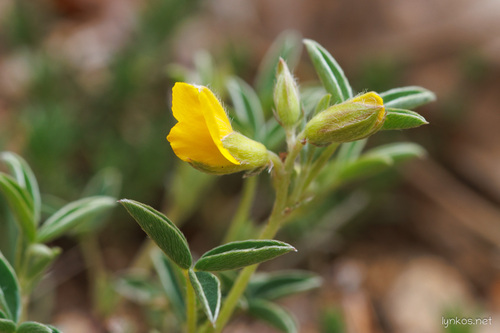
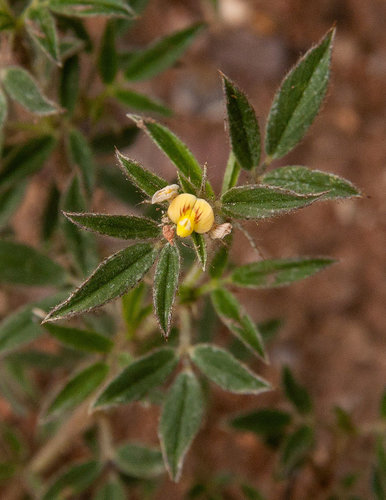
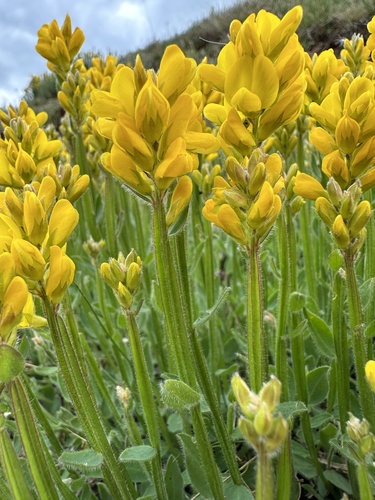
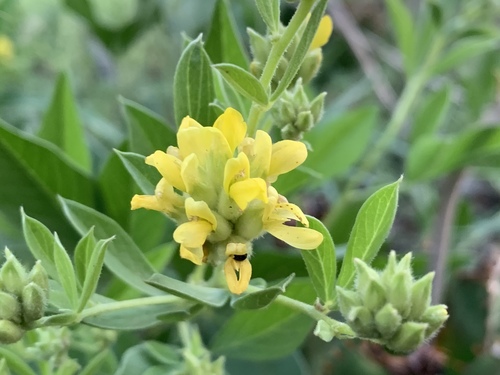
Pearsonia cajanifolia (Harv.) Polhill has several erect, well-branched stems that grow from a deep taproot, reaching (0.2) 0.4–0.7 (1.5) m in height. Stems are covered in pubescent to tomentose hairs. Most leaves are 3-foliolate, while upper leaves are 1-foliolate and intergrade into bracts. Leaflets measure 3–6.5 (9) × 0.8–2.5 (3) cm, shaped oblanceolate to elliptic or obovate, with an apiculate tip, and have indumentum ranging from thinly pubescent to silvery sericeous-tomentose. Lower lateral nerves of leaflets are steeply ascending, and reticulate venation is rather prominent. The petiole is 0.5–2.8 cm long, and stipules are 0.4–1 (1.4) cm long, linear-subulate in shape. Flowers are yellow, arranged in heads or short dense racemes that hold (3) 8–30 (40) flowers each; these inflorescences are often aggregated into panicles when upper leaves are suppressed. Bracts subtending individual flowers are 4–8 mm long, linear or linear-lanceolate, and slightly smaller bracteoles grow on the very short pedicels. The calyx is 6–10 mm long and tomentose. The upper lip of the calyx is approximately 1–1.5 times as long as the calyx tube, with lateral sinuses reaching the same height as or higher than the upper sinus. Upper calyx lobes are 2–4 mm long, shaped narrowly to broadly triangular-acuminate. The standard petal measures 8–13 × 3–7 mm, is usually elliptic-oblong, and is pubescent on its outer surface. All stamens are joined together. The ovary contains 6–12 ovules. The pod is only slightly extended beyond the calyx, measures 6–8 × 3–4 mm, shaped oblong-ellipsoid, and is covered in pubescent hairs; it usually produces only 2 seeds. Seeds are approximately 1 mm long and oblique-cordiform in shape.