About Patersonia sericea R.Br.
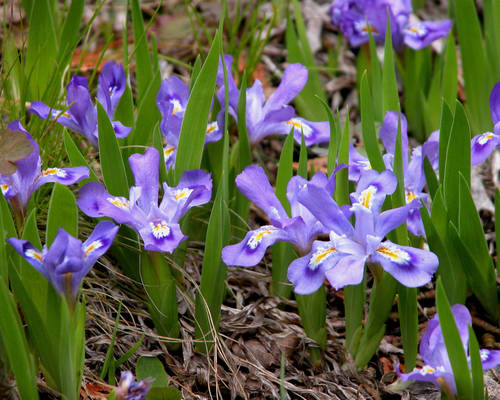
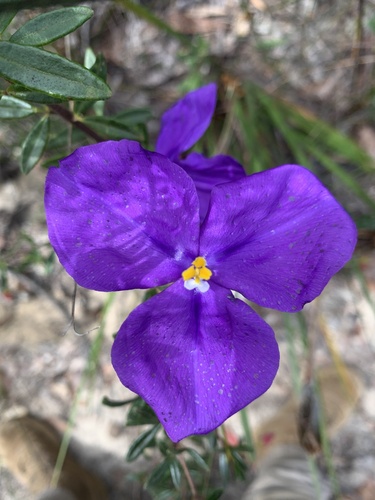
Patersonia sericea R.Br., commonly known as purple flag or silky purple-flag, is a densely-tufted perennial herb that grows up to 60 cm (24 in) tall. It produces linear, sword-shaped, grass-like green leaves that measure 120–600 mm (4.7–23.6 in) long and 1–6 mm (0.039–0.236 in) wide. Its flowering scape is 3–55 cm (1.2–21.7 in) long, with an egg-shaped to lance-shaped sheath that encloses the flowers; the sheath is dark brown to blackish, prominently veined, and 20–60 mm (0.79–2.36 in) long. The outer tepals are bluish-violet, 20–30 mm (0.79–1.18 in) long and 15–25 mm (0.59–0.98 in) wide, while the inner tepals are about 2 mm (0.079 in) long. The stamen filaments are 4–6 mm (0.16–0.24 in) long and joined for part of their length. Flowering occurs mainly from June to November; each flower is open for only one day, but each stem produces many flowers. The fruit is an oval capsule 15–25 mm (0.59–0.98 in) long. Two varieties of this species have distinct distributions and habitats: Patersonia sericea var. longifolia (purple flag) grows in open forest and heath on coastal and range soils derived from sandstone, ranging from the Hunter River in New South Wales to the Genoa River in far north-eastern Victoria. Patersonia sericea var. sericea (silky purple-flag) grows in forest, woodland and heath on the coast and tablelands, on soils derived from sandstone or granite, and is found in south-eastern Queensland, eastern New South Wales and eastern Victoria. Ecologically, Patersonia sericea serves as larval food for two butterfly species: the eastern iris-skipper (Mesodina halyzia) and the montane iris-skipper (Mesodina aeluropis). In horticulture, it is a reliable cultivated species that thrives in hot, dry locations and is also frost tolerant. It is useful when grown en masse in a bed of perennial plants.