About Patersonia occidentalis R.Br.
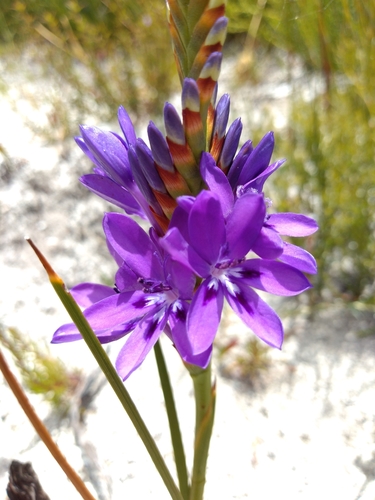
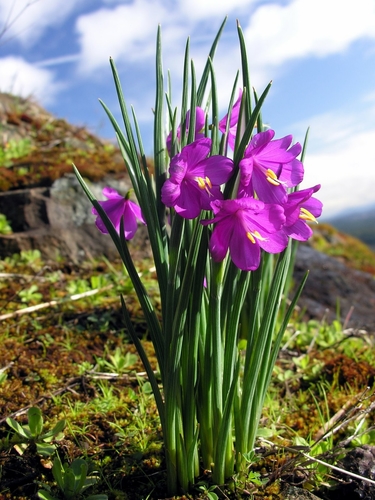
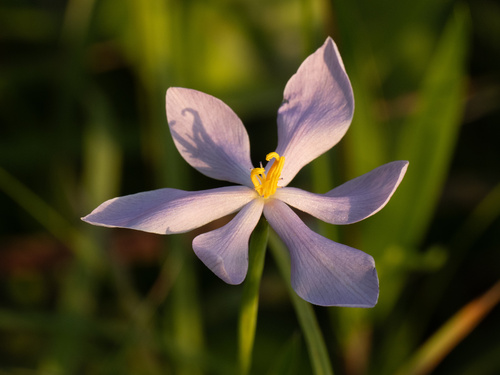
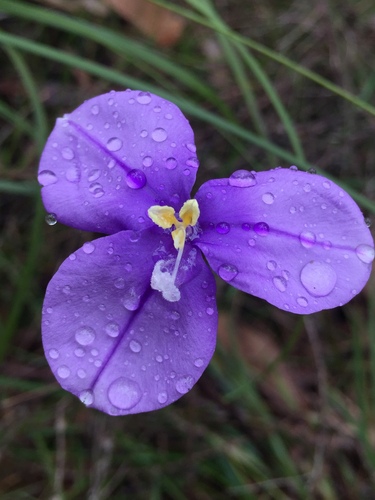
Patersonia occidentalis R.Br. is a tufted, rhizome-forming perennial herb that typically grows up to 1.5 metres (4 feet 11 inches) tall. It produces four to ten sharply-pointed, hairless, strap-like leaves that measure 80 to 550 millimetres (3.1 to 21.7 inches) long and 2 to 10 millimetres (0.079 to 0.394 inches) wide. The flowering scape is 10 to 80 millimetres (0.39 to 3.15 inches) long, with an elliptic to lance-shaped, brown flower-enclosing sheath that is 30 to 50 millimetres (1.2 to 2.0 inches) long. Its sepals are bluish-violet, 20 to 35 millimetres (0.79 to 1.38 inches) long and 12 to 22 millimetres (0.47 to 0.87 inches) wide; the petals are lance-shaped, and the stamen filaments measure 4 to 7 millimetres (0.16 to 0.28 inches) long and are joined together. Flowering occurs mainly from September to December; each individual flower stays open for one day, but each stem produces many flowers. The fruit is a cylindrical capsule 18 to 25 millimetres (0.71 to 0.98 inches) long. This species, commonly called purple flag, is distributed across Western Australia, South Australia, Victoria and Tasmania. In Western Australia, it is widespread and common between the Murchison River in the north and Israelite Bay in the south, where it grows in winter-wet areas, on sand dunes, and around granite outcrops. In South Australia, it only occurs in the south-east of the state, growing in heath and clearings, usually on poorly-drained sites. In Victoria, it is widespread in near-coastal areas on poorly-drained sites. In Tasmania, it forms clumps in swampy areas in the north and east of the state. In horticulture, this species is cultivated in gardens, is frost tolerant, and can grow successfully in dry positions.