About Patersonia glabrata R.Br.
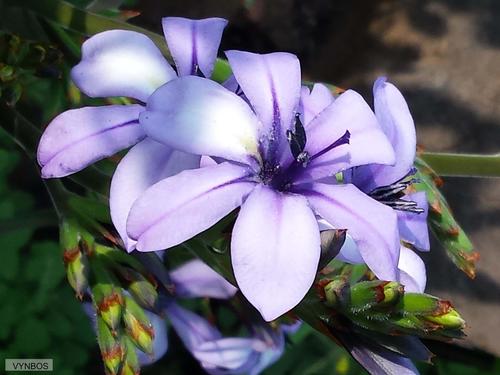
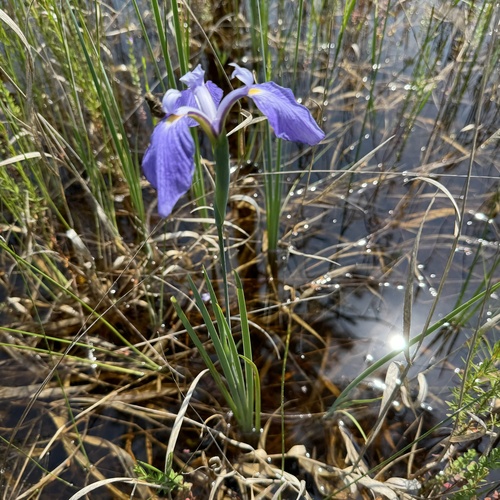
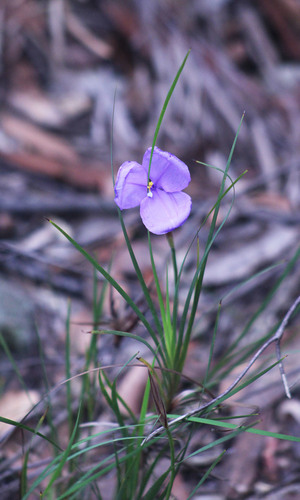
Patersonia glabrata R.Br., commonly called leafy purple-flag, is a perennial herb or subshrub. It typically grows 30 to 80 centimeters (12 to 31 inches) tall and produces a small number of woody stems. Its leaves are linear, 100 to 400 millimeters (3.9 to 15.7 inches) long, and 2 to 4 millimeters (0.079 to 0.157 inches) wide. The leaves are mostly glabrous, except for tiny hairs located near the edges of the leaf base. The glabrous flowering scape measures 100 to 300 millimeters (3.9 to 11.8 inches) long. The sheath that encloses the flowers is lance-shaped, 40 to 65 millimeters (1.6 to 2.6 inches) long, and dark brown. The petal-like sepals are pale violet, ranging from egg-shaped to roughly round, 20 to 30 millimeters (0.79 to 1.18 inches) long, and 15 to 26 millimeters (0.59 to 1.02 inches) wide. The stamens have filaments 5 to 7 millimeters (0.20 to 0.28 inches) long that are joined for most of their length. Flowering takes place from August to October. The fruit is a cylindrical capsule 20 to 40 millimeters (0.79 to 1.57 inches) long, which holds seeds approximately 4 millimeters (0.16 inches) long. This species grows on the coast and tablelands of eastern Australia, ranging from 18°South in Queensland, through New South Wales, to Bairnsdale in Victoria, with separate disjunct populations located on Wilsons Promontory and French Island. It occurs in forest, woodland, and coastal heath habitats.