About Patania ruralis (Scopoli, 1763)
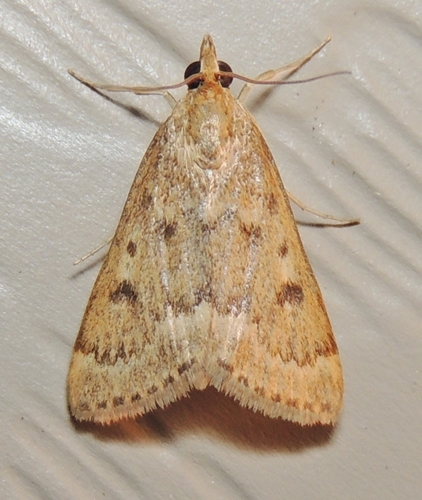
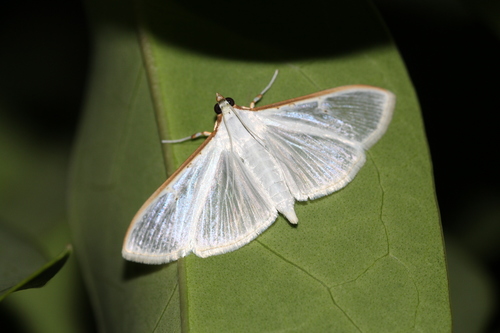
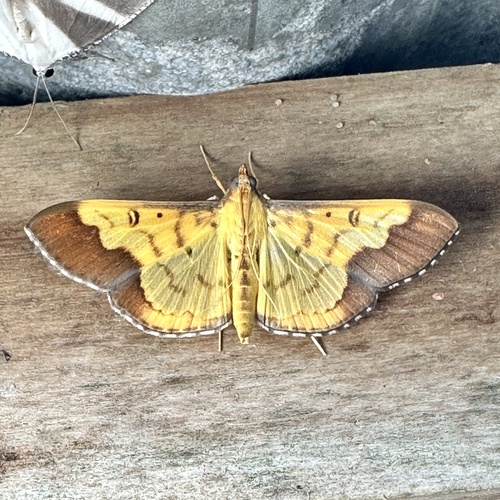
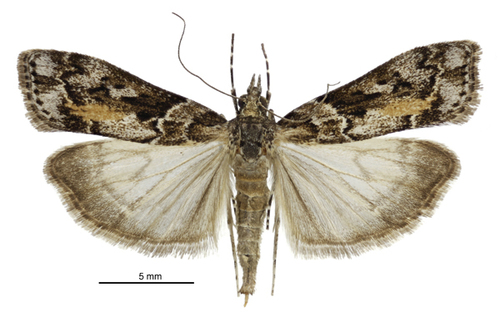
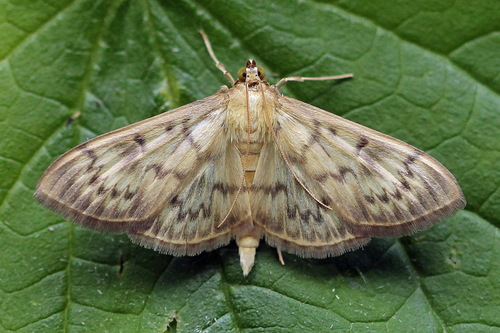
Patania ruralis has a wingspan ranging from 26 to 40 millimetres (1.0–1.6 inches). Its forewings are pale whitish-ochreous with a yellowish tinge, featuring a grey subcostal suffusion and connected orbicular dot. The forewing lines are rather dark grey: the first line is straight, while the second is serrate, curved, and strongly broken inwards beneath the middle. A dark grey discal mark sits on the forewing, nearly followed by a grey blotch, and there is a grey terminal band with an edge parallel to the second line. The hindwings match the forewings in color, discal mark, and posterior markings. The caterpillar larvae of this species are whitish green, with greener sides, a darker dorsal line, and a green head.
The larvae feed primarily on stinging nettle (Urtica dioica) and small nettle (Urtica urens). Less frequently, they have been found feeding on hops (Humulus lupulus), another member of the urticalean nettle clade of the Rosales. Occasional foodplant records from the Caryophyllales order include goosefoot (Chenopodium) and orache (Atriplex). The caterpillars are notable for their rolling locomotion, and their rolling behavior has been used as a model to develop next-generation rolling robots.