About Patagioenas leucocephala (Linnaeus, 1758)
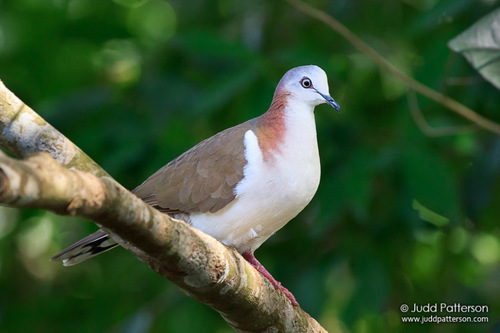
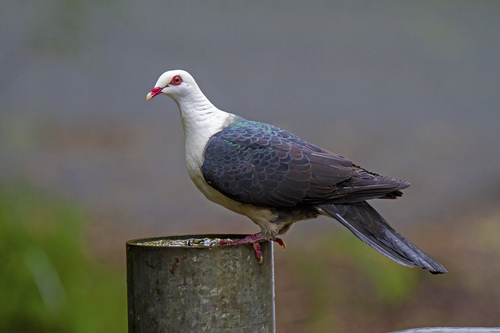
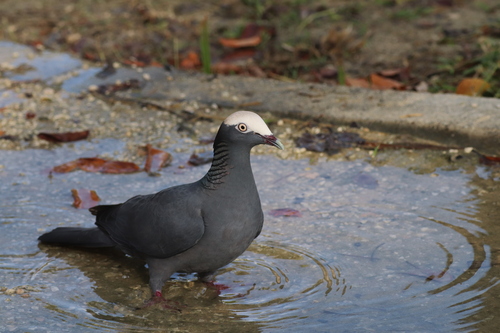
The white-crowned pigeon, Patagioenas leucocephala, measures 29–35 cm (11–14 in) in length, has a wingspan of 48–59 cm (19–23 in), and weighs 150–301 g (5.3–10.6 oz). It is roughly the same size as the common rock pigeon, but weighs slightly less because it is generally less stocky, and has a relatively longer, more square tail. The plumage of adult birds ranges from slate gray to nearly black. Its iridescent collar patch is only visible under good lighting, where it shines with a barred white pattern that has green tones. The species' distinct crown patch varies in shade: it is brighter white in males, and more gray-white in most females. Adults have a white iris and a red bill with a pale tip. Juveniles are a lighter, less dark shade of gray, lack the nape pattern and white iris, and only have a few pale feathers on the crown. The call of this species is a loud, deep coo-cura-coo or coo-croo. This species is part of a diverse clade of Patagioenas that vary greatly in appearance, but are united by their triple coos, with the exception of the scaled pigeon. This species is a resident breeder that occurs mainly in the Bahamas, Cuba, Jamaica and Antigua. It breeds in smaller numbers in Hispaniola (which includes the Dominican Republic and Haiti), Puerto Rico, the Virgin Islands, the Cayman Islands, Anguilla and other Caribbean islands. It also breeds along the Caribbean coast of Central America. In the United States, it is found only in the Florida Keys, the Everglades, and the southern tip of mainland Florida. Individuals often spend the winter on Caribbean islands. The species has been spotted as far south as Fuerte Island, off the northern coast of Colombia. The white-crowned pigeon primarily lives and breeds either in nest colonies or individually in low-lying coastal mangrove forests, and travels inland to feed on the fruits and seeds of a wide variety of plants. In Florida, the white-crowned pigeon was historically recorded as nesting exclusively on remote, tidally inundated mangrove islands within wildlife refuges. Recent observations have confirmed that the species now also nests on the southern tip of mainland Florida. With few exceptions, this species requires isolated offshore mangrove islets with limited disturbance for breeding. These tidally inundated mangrove islands provide some protection from predators such as raccoons. However, several recent instances of white-crowned pigeons nesting in heavily trafficked urban areas, such as downtown Key West and Miami, Florida, have been observed. This shift may be due to habitat loss caused by hurricanes, increased predation pressure in the species' historic nesting habitat, or both.