About Pastinaca sativa L.
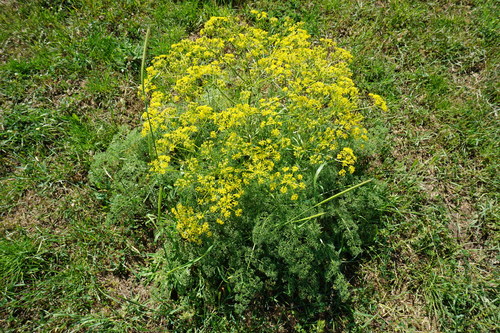
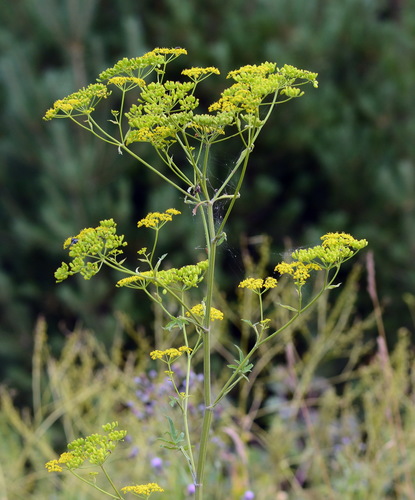
Pastinaca sativa L., commonly known as parsnip, is a biennial plant that grows a rosette of roughly hairy leaves in its first year; these leaves release a pungent odor when crushed. It is cultivated for its fleshy, edible, cream-colored taproot. The taproots are generally smooth, though lateral roots sometimes develop. Most roots have a narrowly conical shape, but some cultivars have a more bulbous shape, which is typically preferred by food processors because it is more resistant to breakage. The plant's apical meristem produces a rosette of pinnate leaves, each with several pairs of leaflets with toothed margins. Lower leaves have short stems, while upper leaves are stemless, and terminal leaves have three lobes. Leaves are once- or twice-pinnate, with broad, ovate, sometimes lobed leaflets that have toothed margins; mature leaves can grow up to 40 centimetres (16 inches) long. Leaf petioles are grooved and have sheathed bases. A flowering stem develops in the plant's second year and can reach over 150 cm (60 in) tall. This stem is hairy, grooved, hollow (except at the nodes), and sparsely branched. It bears a small number of stalkless, single-lobed leaves 5 to 10 cm (2 to 4 in) long, arranged in opposite pairs. The plant's yellow flowers grow in a loose, compound umbel 10 to 20 cm (4 to 8 in) in diameter. There are 6 to 25 straight pedicels, each 2 to 5 cm (1 to 2 in) long, that support smaller secondary umbels called umbellets. Umbels and umbellets usually do not have upper or lower bracts. Flowers have tiny sepals or no sepals at all, and measure around 3.5 millimetres (1⁄8 in). Each flower has five yellow petals curled inward, five stamens, and one pistil. The fruits, called schizocarps, are oval and flat, with narrow wings and short, spreading styles. They range in color from straw to light brown, and measure 4 to 8 mm (3⁄16 to 5⁄16 in) long. Despite small morphological differences between wild and cultivated plants, wild parsnip is the same taxon as cultivated parsnip, and the two can readily cross-pollinate. Parsnip has a chromosome number of 2n=22. Like carrots, parsnips are native to Eurasia. The shoots and leaves of parsnip require careful handling, because their sap contains furanocoumarins: phototoxic chemicals that cause skin blisters when the exposed skin is exposed to sunlight, a condition called phytophotodermatitis. Parsnip shares this trait with many of its relatives in the carrot family. Symptoms of exposure include redness, burning, and blisters; affected areas can remain sensitive and discolored for up to two years. There have been reports of toxic symptoms in gardeners who have come into contact with parsnip foliage, but these cases are rare compared to the total number of people who grow the crop. Reactions are most likely to occur on sunny days when gathering foliage or pulling up old plants that have gone to seed. Reported symptoms are mostly mild to moderate. Exposure risk can be reduced by wearing long pants and sleeves to avoid contact with sap, and avoiding sunlight after any suspected contact. If sap enters the eyes, it can cause blindness. The toxic properties of parsnip extracts remain active after heating and after several months of storage. Toxic symptoms can also affect livestock and poultry, in areas of their bodies where their skin is exposed. Polyynes found in Apiaceae vegetables including parsnip show cytotoxic activities. Parsnips resemble carrots and can be used in similar cooking ways, but they have a sweeter taste, especially after cooking. They can be prepared by baking, boiling, pureeing, roasting, frying, grilling, or steaming. Added to stews, soups, and casseroles, they contribute a rich flavor. In some preparations, parsnips are boiled and the solid pieces are removed from the soup or stew, leaving a more subtle flavor than whole root and starch to thicken the dish. Roast parsnip is considered an essential part of Christmas dinner in some parts of the English-speaking world, and is frequently included in the traditional Sunday roast. Parsnips can also be fried or thinly sliced to make crisps, and can be fermented into a wine with a flavor similar to Madeira. Author Dorothy Hartley described parsnips as having "the type of sweetness that mingles with honey and spice...". Food writer Alan Davidson remarked, "parsnip has a taste which, although not strong, is peculiar and not to everyone's liking." In Roman times, parsnips were believed to be an aphrodisiac. However, parsnips are not typically used in modern Italian cooking; instead, they are fed to pigs, particularly those raised to produce Parma ham.