About Passiflora tarminiana Coppens & V.E.Barney
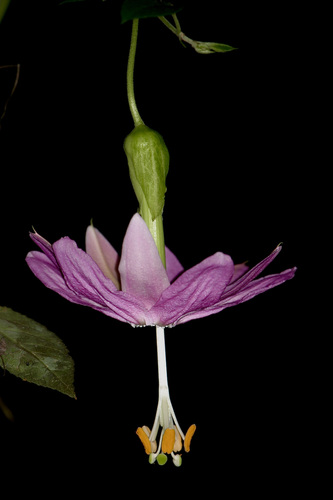
Passiflora tarminiana is a high climbing vine with hairy stems and petioles. Where petioles join the stem, it bears stipules that measure 4–7 by 2–3 mm, which are soon deciduous. Its leaves are three-lobed, hairy on the underside and usually hairless on the upper surface. Flowers are solitary and hang downward. Pale green bracts at the base of the flower enclose a swollen nectary chamber. The floral tube, also called the hypanthium, is 6–8 × 0.7–1 cm and pale green. Sepals and petals are 3–6 cm long, pink, and positioned perpendicular to the floral tube or reflexed. Fruits taper at both ends, measuring 10–14 cm long by 3.5–4.5 cm wide, and ripen to yellow or light orange. Fruits contain many seeds embedded in an edible, orange aril. P. tarminiana, previously grouped with Passiflora tripartita var. mollissima as the single species P. mollissima, can be distinguished from this taxon by several features: P. tarminiana has small deciduous stipules, while P. tripartita var. mollissima has larger, persistent stipules. In P. tarminiana, sepals and petals are perpendicular to the floral tube or reflexed, and they are longer relative to the floral tube; in P. tripartita var. mollissima, flowers never open this widely, and sepals and petals are much shorter relative to floral tube length. The related Passiflora mixta and P. tripartita var. mollissima (formerly called mollissima) are vigorous climbing vines growing up to seven metres, with cylindrical stems densely covered in yellow hairs. Their leaves are shiny green with clearly defined veins; their large flowers have pink and green petals and a yellow and white centre. Ripe fruits are yellow-orange, containing sweet edible orange pulp with black seeds. Passiflora tarminiana is native to the uplands of tropical South America, but its exact native range is uncertain because it has been widely cultivated across the region. It occurs and is cultivated between approximately 2000 and 3000 metres in the Colombian highlands, and the Venezuelan, Peruvian, and southern Ecuadorean Andes. It has naturalized in Australia, Guam, Hawaii, New Zealand, and Zimbabwe, and is classified as an invasive species in both Hawaii and New Zealand. It is widely cultivated around the world, including in California, Réunion, Mexico, Panama, and Papua New Guinea. The common name banana passionfruit refers to this group, which is native to Andean valleys from Venezuela to Bolivia. It was domesticated and cultivated by various western South American cultures since pre-Columbian times, before the Spanish Conquest. Today it remains in common cultivation, and its fruits are regularly sold in local markets. In California, the vine is grown as an ornamental under the name "softleaf passionflower"; it is also grown to some extent in Hawaii, Madeira, and the state of Tamil Nadu, India. Passiflora tarminiana is cultivated for its edible fruit. It is the second most common cultivated species of this group in South America, after P. tripartita var. mollissima, and is considered more disease resistant than that species. Its fruit is also eaten in New Zealand, while Hawaiian sources consider the fruit insipid. Its pink showy flowers also make it a popular ornamental species.