About Passiflora lutea L.
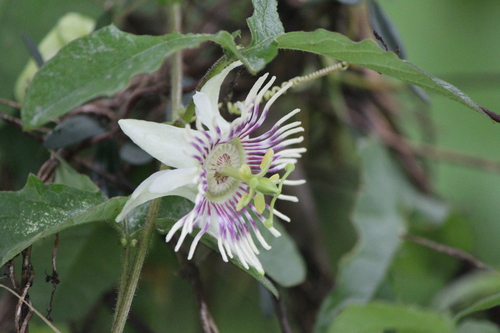
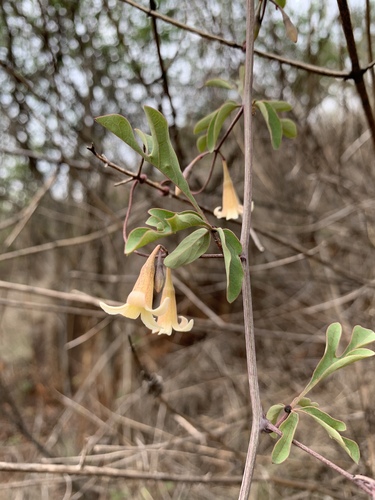
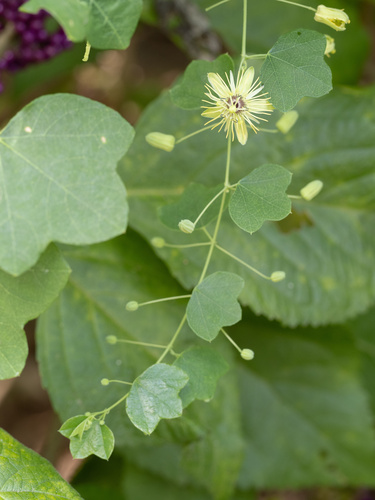
Passiflora lutea L. (P. lutea) is a perennial herbaceous climbing or trailing unbranched vine that can reach 3–5 meters (10–16 feet) in length. Curled springlike tendrils emerging from leaf axils help the vine climb on structures or other vegetation. Its leaves are trilobed, 3–7 cm (1–3 in) long and 3–15 cm (1–6 in) wide, with a 5 cm (2 in) petiole. Leaves have smooth entire margins and grow alternately along the stem. The upper leaf surface is dark green, and may be mottled with lighter green splotches. In the northern part of its range, this species is deciduous. Its showy flowers grow singly or in pairs on slender stalks up to 5 cm (2 in) long. Each flower is 1.5–2.5 cm (0.6–1.0 in) wide, with narrow yellowish-green petals and broader green sepals. The fruit can be up to 1.5 cm (0.6 in) long; it starts green and turns dark purple or black when ripe. Each fruit holds up to 10 brown seeds, which are pointed at both ends and have a textured surface. P. lutea is native to the United States, ranging from Pennsylvania west to Kansas, and south to Florida and Texas. It is the northernmost species in the Passiflora genus, occurring slightly further north than Passiflora incarnata. It tolerates winter temperatures as low as −15 °C, and can survive even −30 °C for short periods. It grows in habitats from bright shade to sunny locations with moist, rich soil, such as open woodlands and low alluvial ground. Yellow passionflower is often a good choice for butterfly gardens, as it acts as a host plant for Julia butterflies (Dryas iulia), Mexican and Gulf fritillary butterflies, zebra longwings (Heliconius charitonius), and Crimson-patched longwing butterflies (Heliconius erato). It is also the only pollen source used by the unusual specialist solitary bee Anthemurgus passiflorae, which is the only member of its genus. This rare bee has an obligate oligolectic relationship with the plant, but it rarely pollinates Passiflora lutea.