About Passiflora edulis Sims
Passiflora edulis Sims is a perennial climbing vine that produces tendrils from leaf axils; young tendrils have a red or purple hue. This species has two main varieties: the purple-fruited Passiflora edulis f. edulis, and the yellow-fruited Passiflora edulis f. flavicarpa.
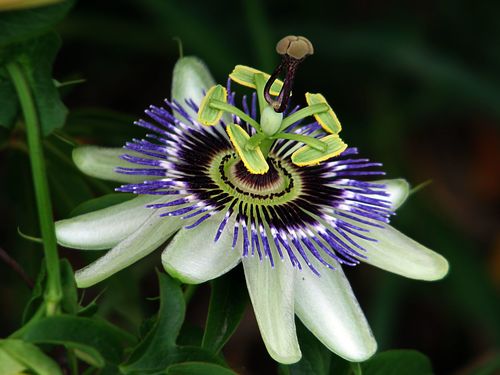
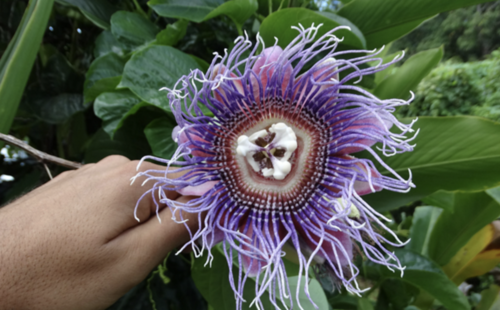
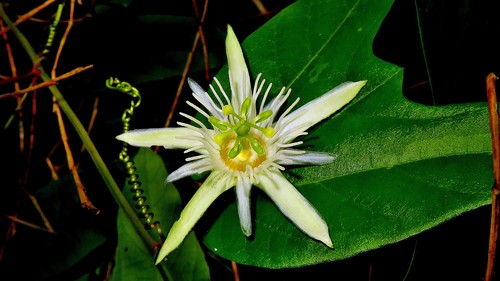
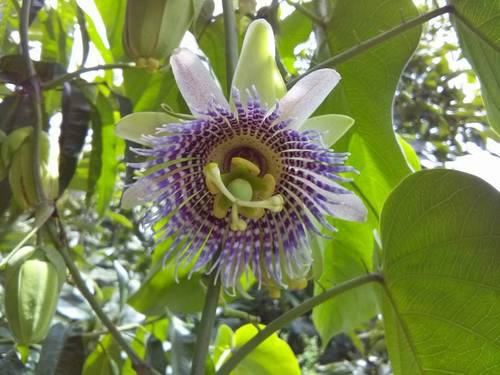
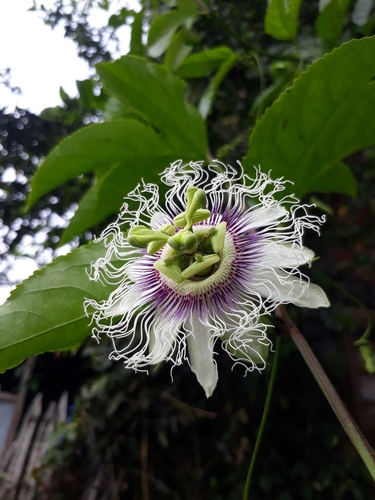
Each vine node usually produces a single flower, which measures 5–7.5 cm wide. The flower has 5 oblong green sepals and 5 white petals; both sepals and petals are 4–6 mm long and arranged to form a fringe. The base of the flower is a deep purple, and holds 5 stamens, an ovary, and a branched style. The styles bend backward, and the stigmas located at the tip of each style have a very distinct head.
The fruit of Passiflora edulis is a pepo, an entirely fleshy structure that is classified as a berry botanically. Fruits range in shape from spherical to ovoid, and their outer rind color varies from dark purple with fine white specks to light yellow. Fruit diameter ranges from 4–7.5 cm; purple fruits are smaller, weighing around 35 grams, while yellow fruits are closer to 80 grams. The fruit has a smooth, leathery rind 9–13 mm thick that includes a thick layer of pith. A ripe fruit typically contains around 250 brown seeds, each 2.4 mm long. Each seed is surrounded by a membranous sac filled with pulpy juice. The juice has a slightly acidic, musky flavor, similar to that of guava.
Passiflora edulis is native to the geographic area spanning from southern Brazil through Paraguay to northern Argentina.
The flowers of the yellow-fruited form are self-sterile, while the flowers of the purple-fruited form are self-compatible. In California, pollination is most effective when done by carpenter bees. Yellow passion fruit flowers are grouped into three types based on the curvature of their styles. Some gardeners place decaying logs near the vines to provide shelter for carpenter bees, to help ensure successful pollination.
Passiflora edulis is widely cultivated across tropical and semitropical regions of the world. In the United States, it is grown in Florida, Hawaii, and California. It generally requires protection from frost, though certain cultivars have survived light frosts after heavily pruning affected areas.