About Passiflora cinnabarina Lindl.
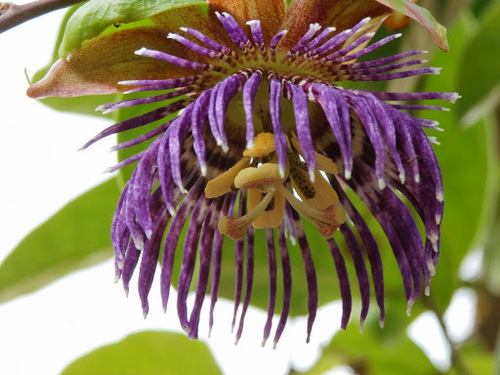
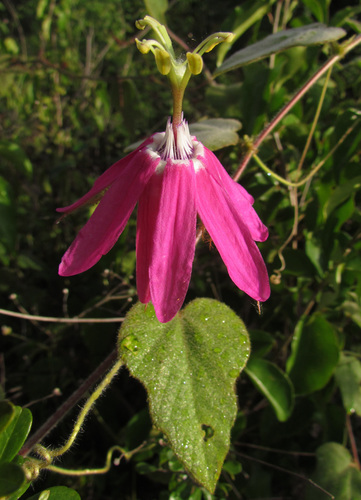
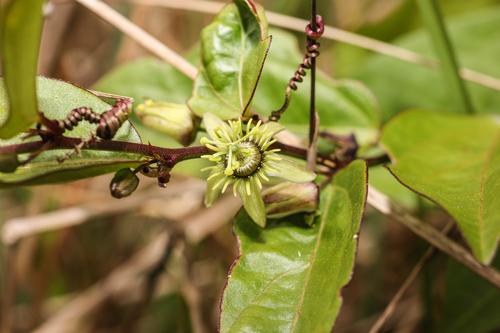
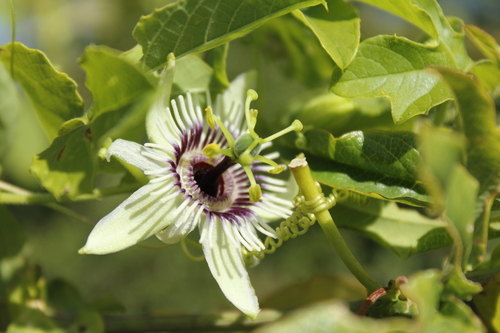
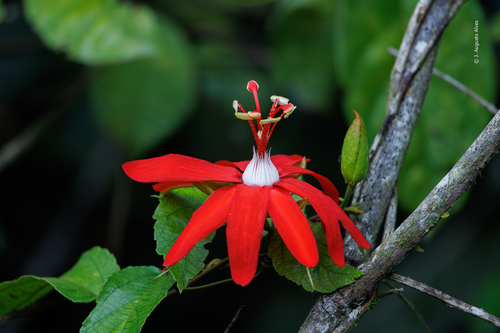
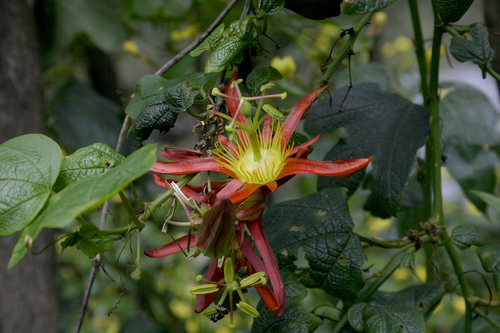
Passiflora cinnabarina Lindl. is a hairless climbing or scrambling vine, with slender stems that reach up to 4 m (13 ft) in length, and simple tendrils that grow from leaf axils. Its leaves are up to 10 cm (3.9 in) long and wide, have three lobes, and grow on a stalk (petiole) 20–50 mm (0.79–1.97 in) long. Narrow, lance-shaped stipules 3–10 mm (0.12–0.39 in) long grow at the base of the petiole. Flowers grow individually from leaf axils, are 4–7 cm (1.6–2.8 in) across, and are borne on a stalk (pedicel) 3–5 cm (1.2–2.0 in) long, with three thread-like bracts at the base of the pedicel. The sepals are 20–35 mm (0.79–1.38 in) long, keeled, red on the inner surface and green on the outer surface. The petals are red, and 8–15 mm (0.31–0.59 in) long. The flower's corona is made up of two rings of filaments: the outer ring is yellow, 6–12 mm (0.24–0.47 in) long, and the inner ring is whitish, usually 5–6 mm (0.20–0.24 in) long. The gynophore is 20–40 mm (0.79–1.57 in) long, and the flower has five stamens and three styles. Flowering takes place from September to January, and the fruit is a green berry. This species, commonly called red passionflower, grows along rivers in rainforest and forest, often on rocky sites. Its native range extends from northern New South Wales, along the coast and mountain ranges through the Australian Capital Territory, to eastern Victoria. It has also become naturalised in a small number of sites in Tasmania. Seeds of Passiflora cinnabarina are dispersed by birds and possibly mammals. The species has become an environmental weed in Victoria, Tasmania, and New Zealand. In horticulture, this climber can be propagated from either seed or cuttings, and will grow in locations from full sun to partial shade. It is relatively tolerant of frost, but requires moist soil to grow.