About Passiflora caerulea L.
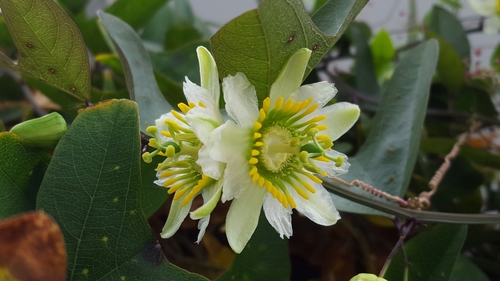
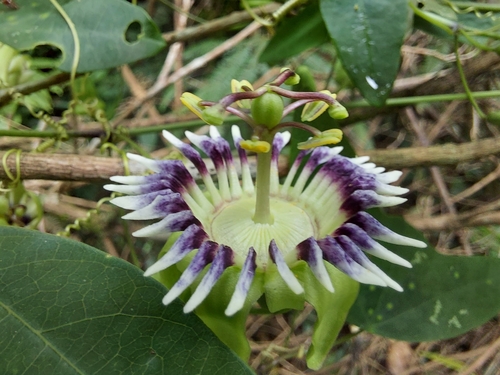
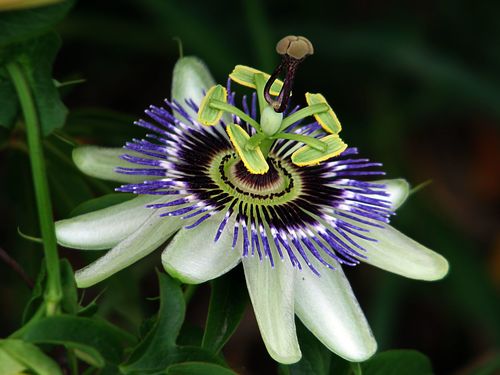
Passiflora caerulea L. is a woody vine that can reach 25 metres (82 ft) in height when growing on supporting trees. Its leaves are alternate, palmately lobed, most commonly with five lobes, though they may sometimes have three, seven, or nine lobes. Leaves are linear-oblong in shape and grow up to 10 centimetres (4 in) in length. At the base of each leaf is a 5–10 cm (2–4 in) long flagellate-twining tendril, which wraps around supporting vegetation to anchor and support the growing plant. The flowers of this species are complex, around 10 cm (4 in) in diameter. It has five sepals and five petals that are similar in appearance, whitish in color, topped by a corona made up of blue or violet filaments. Below the corona are five greenish-yellow stamens and three purple stigmas. The fruit is an oval orange-yellow berry, measuring 6 cm (2+1⁄4 in) long by 4 cm (1+1⁄2 in) in diameter, and contains numerous seeds. Passiflora caerulea is widely cultivated as a wall-climber or as groundcover. It is a hardy species, able to survive winter temperatures as low as −10 °C (14 °F), though it needs a sheltered position that faces south or west when grown in the Northern Hemisphere. This plant can become invasive, as its twining shoots will constantly regrow if not fully eradicated. It is the only Passiflora species that grows as a volunteer in California, and it has received the Royal Horticultural Society's Award of Garden Merit. The ripe fruit of Passiflora caerulea is edible for humans, but its flavor is most often described as bland, undesirable, or insipid. When the fruit is allowed to fully ripen in a warm climate and fall naturally from the vine, it develops a mild blackberry flavor, though it still has lower sugar content than more commonly eaten passion fruit species. A tea can be brewed from the flowers or leaves of this plant. However, the leaves contain the cyanogenic glycosides tetraphyllin B and epi-tetraphyllin B, which release toxic hydrogen cyanide when activated by enzymes. Most of this cyanide can be removed by boiling the plant material before use. In South America, this plant is known for its medicinal uses. It is used to make herbal tea and dietary supplements, and is also added to marmalades, ice creams, syrups, and other beverages. It is also used by the indigenous Toba and Maka peoples of Argentina. Passiflora caerulea is sometimes used as grafting rootstock for the scion of the edible passion fruit species Passiflora edulis.