About Paspalum vaginatum Sw.
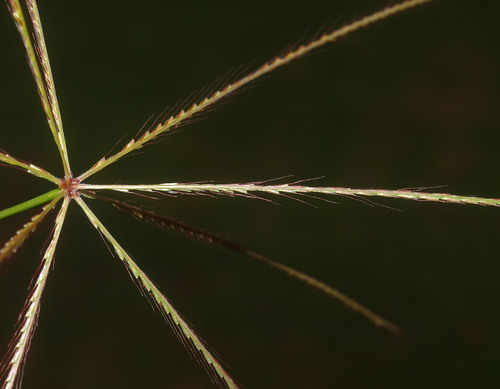
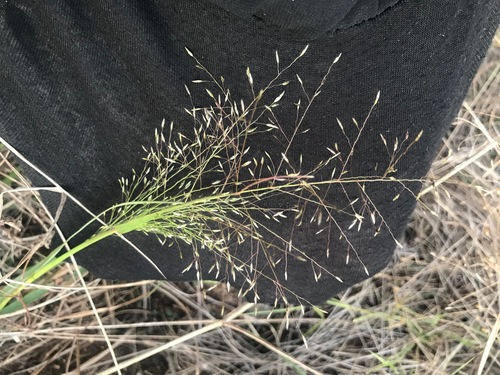
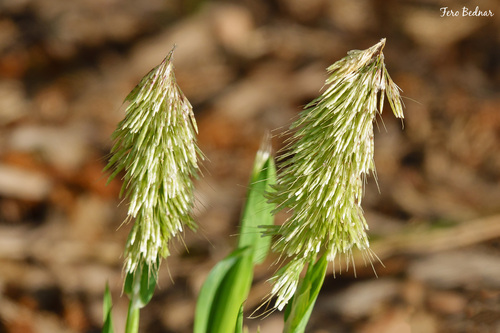
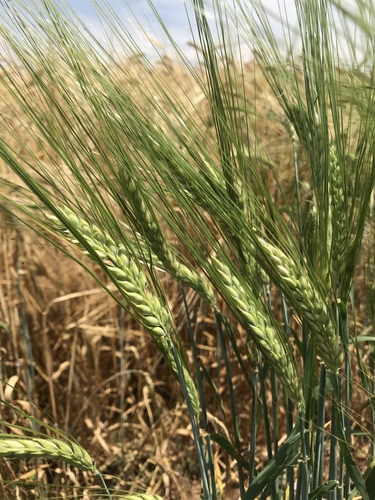
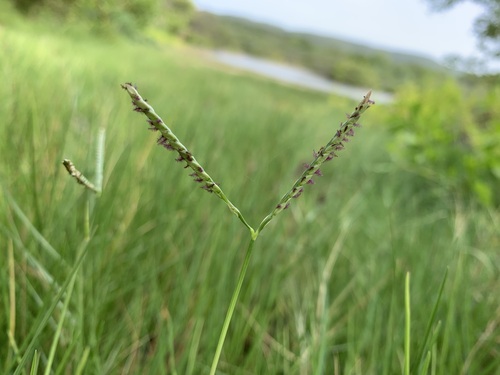
Paspalum vaginatum Sw. is a perennial grass that grows with rhizomes or stolons. Its stems reach heights between 10 and 79 centimetres (3.9 to 31.1 inches). Leaf blades measure 10 to 19 centimetres (3.9 to 7.5 inches) long, range from hairless to slightly hairy, and are typically blue-green in color. Its panicle usually has a pair of branches up to 7.9 centimetres (3.1 inches) long, and sometimes a third branch grows below this pair. Oval to lance-shaped spikelets line the branches, growing pressed against the branches and keeping the panicle narrow. This species is similar to bermudagrass. It spreads via rhizomes and stolons to form a thick turf. In the wild, it grows in salt marshes and brackish marshes. The genome of Paspalum vaginatum was sequenced in 2022, and its haploid genome was found to be approximately 590 megabases in size. This grass has been developed into cultivated varieties used for golf course turf and other landscaping projects. It forms higher quality turf than bermudagrass in poor growing conditions, such as wet soils and low light levels, and requires fewer nitrogen soil amendments. It can grow in lawns that get rain on 250 days per year, and can survive being waterlogged or submerged for several days at a time. It tolerates foot traffic well. Its main advantage is very high salt tolerance: it can be irrigated with non-potable water such as greywater, an important benefit amid increasing water use restrictions, and can even be irrigated with saltwater. Irrigation with saltwater produces lower quality grass than irrigation with potable water, but the grass still survives. This species has filled a niche in America as a preferred turf for areas next to the ocean exposed to sea spray, and it has the highest salt tolerance of all turfgrasses. It is also more competitive against weeds than similar grasses; weeds can be controlled by applying saltwater, which kills weeds while leaving this grass unharmed. Many cultivars have been bred for different uses, and these cultivars are highly variable. For example, fine-textured types are used for golf courses, while coarser grass is selected for roadside revegetation. The best-known and oldest cultivar is likely 'Adalayd', which has a similar texture and blue-green color to Kentucky bluegrass. The cultivar 'Aloha' is a dark green grass used for golf courses and athletic fields. 'Salam', the most common cultivar in Hawaii, is another dark green type suitable for golf courses; its leaves have glossy undersides, which gives the mowed field a striped appearance. 'Seadwarf' is a bright green cultivar that is more resistant to the grass disease dollar spot than other cultivars. Additional uses for the grass include erosion control in sandy coastal areas, which is its native habitat. It can be used for phytoremediation of soils with high heavy metal content, and it has been shown to survive exposure to crude oil pollution. It can be used to feed livestock, and some wild herbivores graze on it. Truist Park, the home ballpark of the Atlanta Braves, uses Seashore Paspalum Platinum TE as its playing field surface.