About Paspalum notatum Flüggé
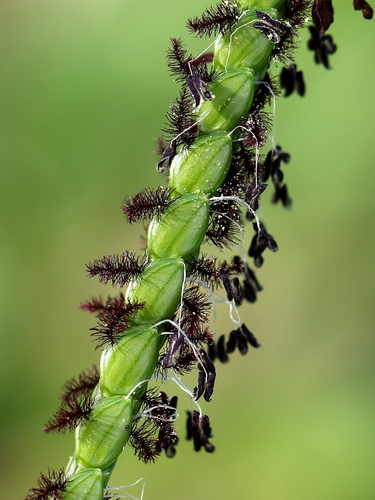
Paspalum notatum Flüggé, commonly known as bahiagrass, common bahia, and Pensacola bahia, is a perennial grass in the Poaceae family that grows in tropical to subtropical regions. It is easily recognized by its prominent V-shaped inflorescence, which is made of two spike-like racemes holding many small spikelets, each measuring 2.8–3.5 millimeters (0.11–0.14 inches) long. This is a low-growing, creeping grass that produces stolons and thick, scaly rhizomes. Its stolons lie tightly against the ground and root freely from their internodes, creating a dense sod. The flat, tough-textured leaves are typically hairless, with blades 2–6 millimeters (0.079–0.236 inches) wide. Leaves may be flat, folded, or inrolled, and taper to a fine point. The leaf bases at the end of each rhizome usually have a purplish color. Mature stems grow between 20 and 75 centimeters (7.9–29.5 inches) tall. The terminal pair of racemes are each attached to the top of a slender stem, with one sometimes positioned slightly lower than the other; a third raceme may occasionally occur. The spikelets overlap closely in two rows. They are broad, rounded, smooth, and shiny. Each spikelet contains a tiny flower, with small black feathery stigmas and black stamens that hang visible from the tips of the flowers. Bahiagrass is native to Mexico and South America, and has become naturalized in other areas of North America and other regions worldwide. It grows best in sandy soils, and tolerates shade. It is also a fairly hardy species, able to withstand saline conditions and drought. This grass is primarily used as forage. Its nutritive value stays high even when mature, but it does not produce very high yields. It is also valued as a soil stabilizer for controlling erosion, appreciated for its productivity, easy establishment, and persistence. It can also form a relatively low-maintenance turf, thanks to its tolerance of minimal upkeep, drought resistance, and lower susceptibility to disease and insect damage compared to some other warm-season grasses. Bahiagrass uses the C4 photosynthetic pathway.