About Pasiphila sandycias (Meyrick, 1905)
Scientific name: Pasiphila sandycias (Meyrick, 1905).
Larval description recorded by Hudson: Full-grown larvae reach approximately 3⁄8 inch in length. They have a very small, pale ochreous head, and a very stout body that tapers toward the head. Body color ranges from dull greyish-green to rich purple, with many intermediate color forms. There is a conspicuous, elongated, triangular blackish mark behind the head that extends to the fifth segment. V-shaped marks are present on segments 6, 7 and 8, which are humped. The remaining segments are paler, with faint irregular lines along the sides, and numerous tiny ring-shaped markings cover the entire body. Larvae of this species are very variable in appearance, and are well camouflaged, as they closely resemble a roughened Coprosma shoot.
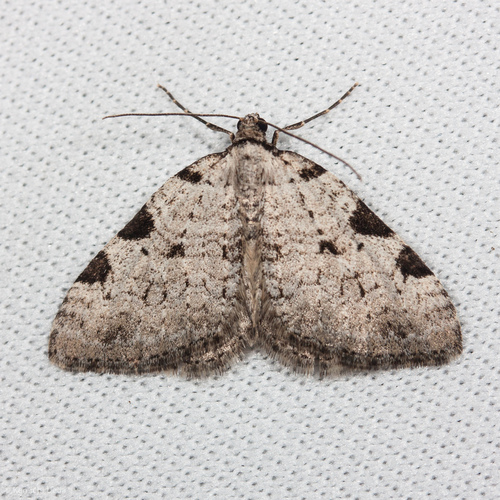
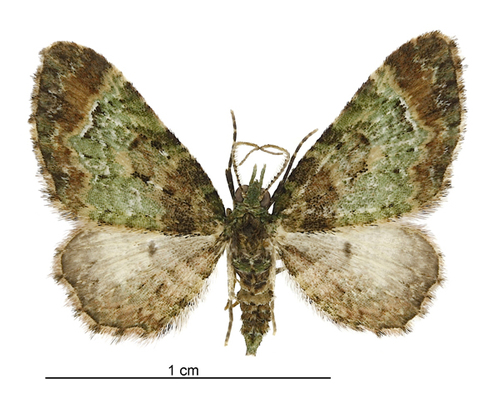
Adult description recorded by Meyrick: Both male and female adults have a wingspan of 14–16 mm. The head and palpi are ochreous-white, and are rarely mixed with green; palpi measure 2+2⁄3. Antennae are white, ringed with dark grey; in males, antennae are ciliated with fascicles (3). The thorax is whitish-ochreous, sprinkled with blackish. The abdomen is ochreous-whitish, more or less tinged with reddish-ochreous toward the base and apex, and variably sprinkled or mixed with blackish. Fore-wings are somewhat elongated-triangular; the costa is faintly sinuate, the apex obtuse, and the termen bowed and rather oblique. Fore-wing color ranges from ochreous-whitish to white. The basal area is more or less tinged with reddish-ochreous and suffusedly striated with blackish irroration, and usually extends much further along the costal area than the dorsal area. The median band is almost always conspicuously pale, sometimes mixed with green, and generally striated with dark irroration on the costa and dorsum, but only rarely indistinct across the entire band. The posterior edge of the median band is formed by a double pale line that is prominently angled in the middle, and is unusually close to the termen on the lower half. When a series of blackish neural dots precedes this line, the dots follow the line’s angulation. There is a blackish linear discal dot, which is sometimes indistinct. The terminal area is reddish-brown, rarely mixed with green, and interrupted by a pale patch opposite the angle of the median band. The subterminal line is pale and waved, and there is an interrupted blackish terminal line. Cilia are whitish, more or less suffused with fuscous-reddish; the basal half is barred with blackish, and the apical half is less distinctly barred with grey. Hind-wings have a sinuate termen, with a rounded prominent section below the middle. Hind-wings are whitish, with obscure striae of reddish and blackish irroration toward the dorsum. There is a rather large blackish-grey discal dot. The terminal area has indistinct grey lines, and is sometimes tinged with reddish. Cilia match those of the fore-wings.
This species can be identified by its small size. Although it is similar in appearance to P. plinthina, it can be distinguished from that species by its much shorter palpi and darker colouration.
Distribution: This species is endemic to New Zealand. It has been observed in the lower half of the North Island, throughout the South Island, and on Stewart Island.
Habitat and hosts: This species prefers native scrub that contains its larval host plants. Larvae of P. sandycias feed on the blossoms of Coprosma areolata and Coprosma rotundifolia. Hudson notes that this species’ larval life stage is synchronised with the flowering of its host plants.