About Parthenium confertum A.Gray
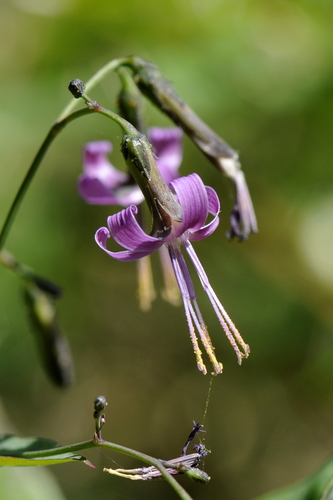
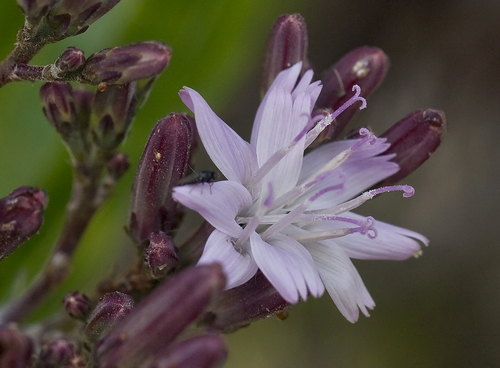
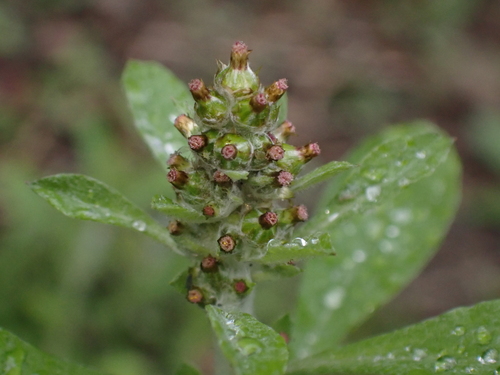
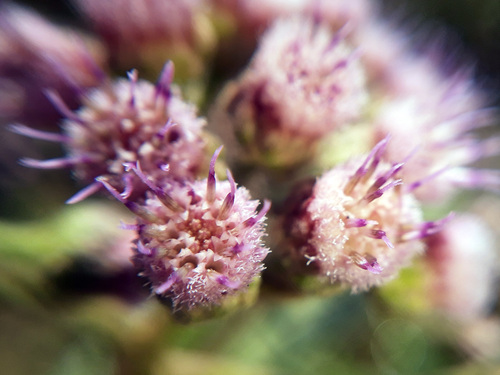
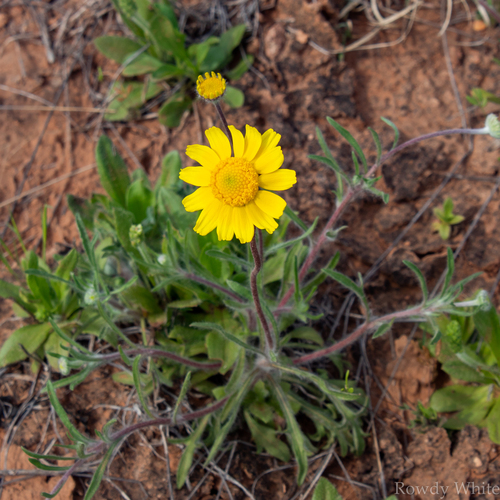
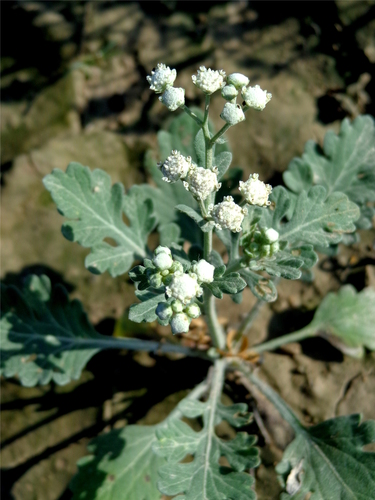
Parthenium confertum A.Gray, commonly called Gray's feverfew, is one of approximately 16 feverfew (Parthenium) species. Like other species in the genus, it produces a characteristic flowering arrangement: very small, white flowering heads. Each head holds roughly five unusually short, widely spaced petal-like ray florets, which surround numerous small, tightly packed disk florets. Ray florets produce tiny, one-seeded cypsela-type fruits, while disk florets usually only produce pollen. The flowering heads are arranged in more or less panicle-shaped inflorescences. Several features distinguish Gray's feverfew from similar Parthenium species. It is a biennial plant that grows up to over 60 cm (~2 feet) tall. Its leaves vary in shape from oval to rounded-triangular or elliptic. Leaf blades usually have irregularly pinnately lobed margins. Leaves can grow to over 120 mm long and over 40 mm wide (~4¾ × 1½ inches). Both leaf surfaces are dotted with glands. Leaves bear stiff, slender, flattened hairs (trichomes), mixed with erect trichomes up to 2 mm (+1⁄16 inch) tall. Disk florets usually number between 20 and 30. Unlike some other Parthenium species that produce white latex in injured parts (a material historically used as a natural rubber source), Parthenium confertum does not produce white latex. In terms of distribution, Parthenium confertum occurs in the Southwestern United States in the states of Arizona, New Mexico, and Texas. In eastern Mexico, it ranges as far south as the state of Querétaro in the country's central highlands. In western Mexico, it occurs in the states of Baja California, Sonora, and Sinaloa. For habitat, in the US state of New Mexico, Gray's feverfew grows in dry, sandy, rocky soils on mesas, in canyons, on hillsides, and in prairies, pinyon-juniper woodlands, scrub, grasslands, and disturbed areas such as roadsides, at elevations of approximately 1200 to 2100 meters (3580–7000 feet). Images show an individual plant growing in a prairie patch within an open forest on a slope of the Edwards Plateau, at an elevation of approximately 1750 m (~5750 feet).