About Parsonsia heterophylla A.Cunn.
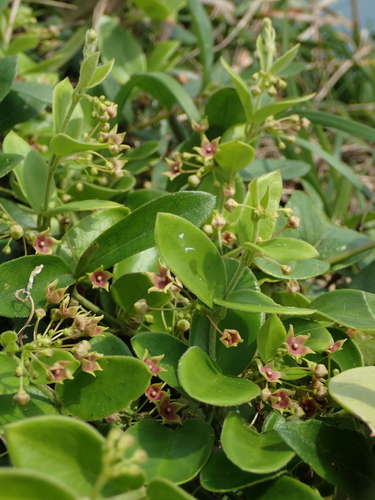
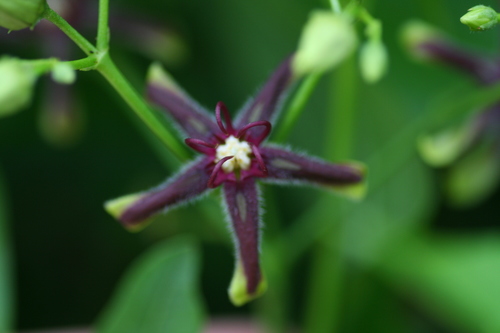
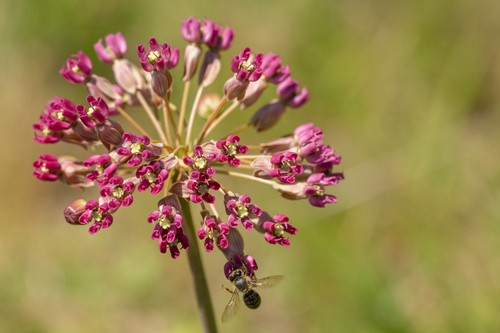
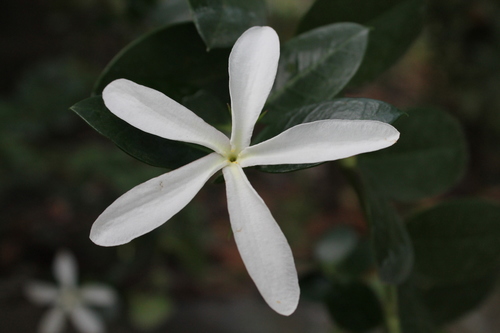
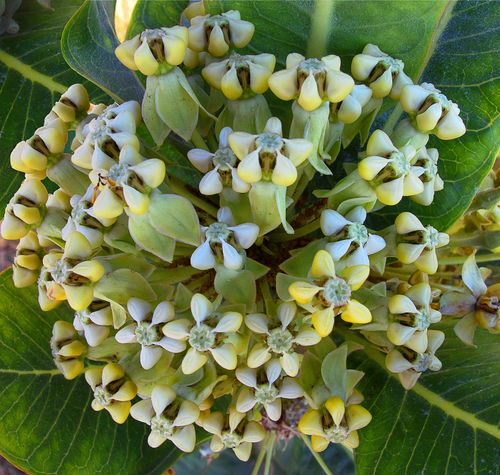
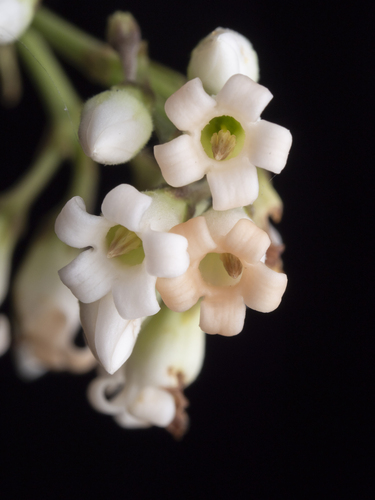
Parsonsia heterophylla A.Cunn. most commonly produces white, fragrant, tubular flowers with anthers hidden inside the tube. Rare observations note this species can also have yellow flowers. Its small flowers, each usually growing up to 8 mm across, are arranged in many-flowered, fairly compact clusters. The flowers are known for their unusual scent, and plants growing draped over the tops of tall trees are more often recognized by scent than by appearance. The fruit of this species is a long, narrow pod that opens to release tufted seeds. These seed pods measure roughly 15 cm long, and each pod holds numerous seeds; every individual seed is tipped with a tuft of silky hairs. The two-valved pod opens from the tip downward, bending outward to lift seeds so their tufts can be caught by wind. The pods start green, turn brown as they mature, and dry empty pods remain hanging on the plant for a long time after seeds have dispersed. Leaves of P. heterophylla vary in size and shape across all life stages. Seedlings and juvenile plants have particularly diverse leaf forms: a mix of small and round, long and narrow, and irregularly shaped leaves can all grow on the same individual. Adult leaves are opposite, rather shiny and dark green on the upper surface, much paler on the underside, mostly smooth-edged but often somewhat wavy. Adult leaves are more than 1 cm wide, most often 2, 3, or 4 cm wide, and grow up to 10 cm long. Though adult leaves are usually shorter and broader than juvenile leaves, they still vary in shape. Leaf forms can be broadly categorized as small round, long narrow, and moderately broad oblong. The twining stems of P. heterophylla are often tightly wrapped around the stems of their host plants. They are described as softly woody and flexible; in older plants, the base of the stem becomes fully woody. Each young stem is about as thick as a quill and has a shiny surface. This branching climber can reach up to 10 metres in height by climbing any nearby plant. P. heterophylla is an endemic species native to New Zealand, found nowhere else in the world. It has been recorded growing on the North Island, South Island, Three Kings Islands, and Stewart Island. It is common across New Zealand in lowland and low montane forest, and prefers growing in forest margins and clearings within coastal scrub patches. It has been observed growing alongside its close relative Parsonsia capsularis on Banks Peninsula, where hybrids between the two species sometimes occur. Little published information exists about the full timeline and life cycle of this species. It flowers from September to March, and seed pods begin developing in February. Wind disperses the species' seeds. For garden cultivation of P. heterophylla, the ideal window for seed collection is between February and April.