About Paropsisterna beata
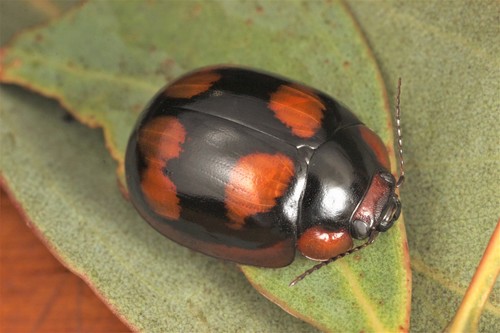
Paropsisterna beata is a beetle that is mostly black, with the exception of an orange head, orange margins on the pronotum, and a narrow orange "skirt" around its elytra. Each of its elytra also has three orange blotches. In some individuals, especially those from the northern part of this species' range, two of the blotches on each elytron are joined together. This species has extremely fine puncturations and striae. One recognized subspecies, Paropsisterna beata rubrosignata, differs in that its elytral blotches are more yellowish, and its marginal colouring is thicker and more reddish. Several other species in the Paropsisterna genus resemble P. beata, but can be distinguished by clear features: P. sexpustulata does not have the coloured lateral skirt around the elytra, and P. octosignata has an entirely black pronotum. As a beetle, P. beata undergoes complete metamorphosis, progressing through four distinct life stages: egg, larva, pupa, and adult. Like other species in its genus, both larvae and adult P. beata feed on the foliage of Eucalyptus trees. The host plants recorded for this species in scientific literature are Eucalyptus grandis and Eucalyptus nitens. Pupation occurs either in leaf litter or within soil. Over the winter, adult P. beata enter diapause, sheltering under loose tree bark, within wood crevices, or in leaf litter under trees.