About Paronychia chartacea Fernald
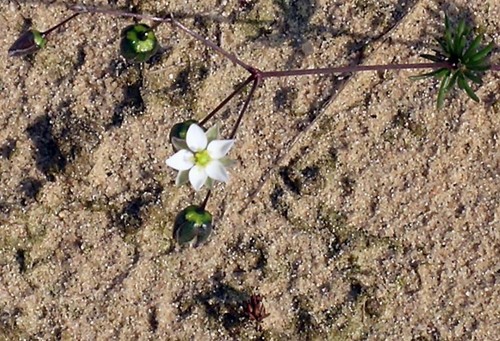
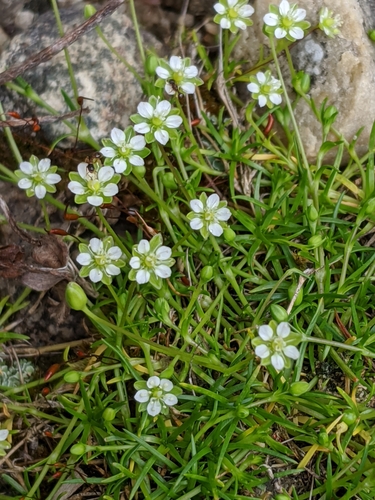
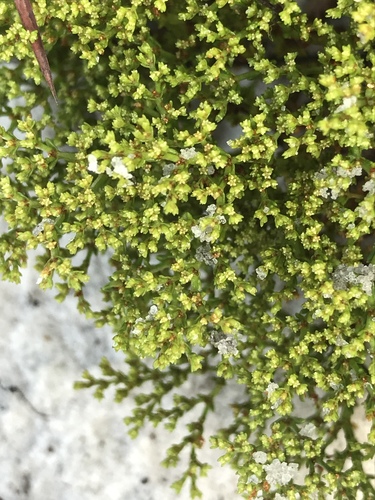
Paronychia chartacea is a rare species of flowering plant in the carnation family Caryophyllaceae, with common names papery whitlow-wort and paper nailwort. It is endemic to Florida in the United States, with two geographically separated, non-overlapping subspecies: subspecies chartacea is found in Central Florida, particularly the Lake Wales Ridge, while subspecies minima is native to the Florida Panhandle. Both subspecies are included on the U.S. federal Endangered Species List, where the species is designated as threatened. The species is most often an annual herb, though subspecies chartacea may also grow as a short-lived perennial. It produces a short, spreading stem that branches many times to form a mat-like shape. The entire stem does not exceed 20 centimeters in length. The stem is lined with occasional small, leathery leaves that range from oblong to triangular in shape and are only a few millimeters long. The ends of the forked stem branches hold dense, highly divided cymes made up of many tiny flowers. Flowers generally have five sepals, stamens, and other floral structures, but may also have 3 or 4 parts, a trait that is unique among North American Paronychia species. The sepals are brownish or purplish, fading to thinned, papery, whitish or translucent edges. The fruit is a tiny utricle that measures just half a millimeter long. The two subspecies differ in size: subspecies minima has a smaller caudex and smaller inflorescences than subspecies chartacea. This plant grows in small openings within Florida scrub, where it is an early successional species, and its populations likely increase after wildfire clears overgrown vegetation. It grows in white sand scrub habitat. The Central Florida subspecies, ssp. chartacea, occurs in open areas dominated by rosemary and sand pine, and sometimes colonizes recently disturbed habitat. Associated plant and lichen species in this habitat include Bonamia grandiflora, Hypericum cumulicola, Polygonella basaramia, Cladonia perforata, Eryngium cuneifolium, and Liatris ohlingerae. The northern subspecies, ssp. minima, grows on white sand edges of ponds and sinkholes in karst substrate, and is found in Bay and Washington Counties, Florida. Though it has a limited distribution and is threatened by loss of its natural ecosystem, the plant can be locally common in remaining fragments of its habitat. The main threat to the species is the destruction and degradation of Florida scrub habitat. This habitat is being cleared for development and converted to agricultural use, such as new citrus groves. Remaining patches of scrub are degraded by fire suppression. Florida scrub depends on periodic wildfire for maintenance; without a natural fire regime, the habitat becomes overgrown and proceeds through succession, where the herb layer is outcompeted and shaded out by larger woody vegetation, turning the open, sunny scrub into closed forest. Some remaining scrub habitat is properly managed to prevent this overgrowth succession, and rare herbs like this nailwort persist in these managed areas. It is one of many rare locally endemic plants that survive on the Lake Wales Ridge, part of which is protected and managed for conservation. Protected habitat for the species is located in Highlands, Polk, Lake, and Orange Counties, Florida.