About Parmotrema perlatum (Huds.) M.Choisy
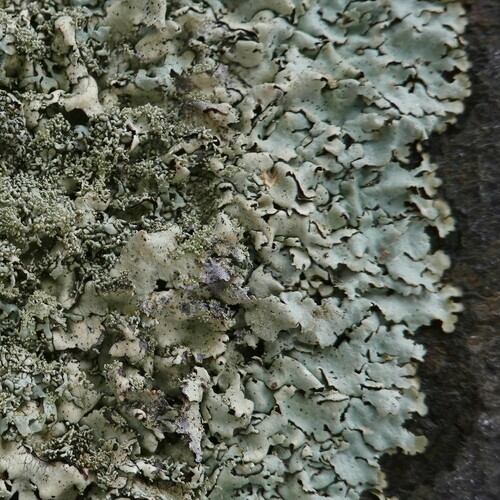
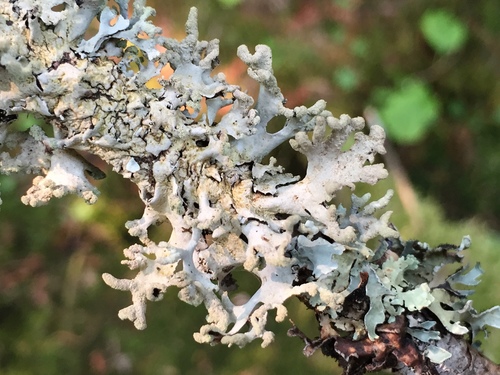
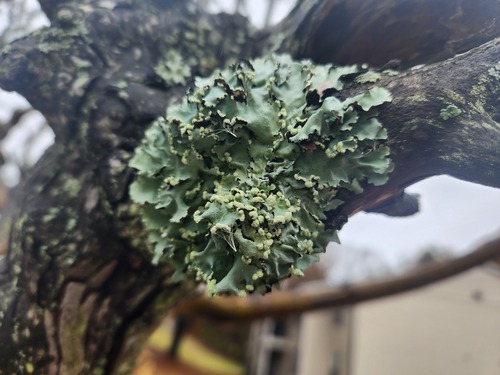
Parmotrema perlatum, formally classified as Parmotrema perlatum (Huds.) M.Choisy, is a foliose lichen with a thallus that attaches from loosely to tightly to its growing surface. It forms large, spreading colonies that often merge together; individual thalli usually reach 10–15 cm (4–6 in) in diameter. The upper thallus surface is colored greenish-grey, blue-grey, or yellowish-grey, has no pruina, and is either spotless (immaculate, lacking maculae) or has only very few maculae; it can also range from whitish grey to pale greenish-grey, and is either smooth or slightly wrinkled, with scattered shallow cracks. Isidia are absent in this species. This lichen produces granular asexual reproductive structures called soredia, which are white, but may turn grey from wear. Soredia are contained within soralia, structures that are linear to oval in shape, most often found along lobe edges. The presence of soredia causes lobe margins to curl back and form capitate soralia. The lichen’s lobes are between 1.5 and 10 mm wide, arranged in overlapping (imbricate) patterns, and have undulate or ruffled shapes. Lobe tips and edges are typically smooth and rounded, sometimes notched (crenate) or incised, and often curl upward or inward, exposing the paler brown to black underside. The underside has hair-like cilia up to 2.5 mm long, and rhizines are common across the underside except for a brown border near the lobe edges. Fruiting bodies called apothecia are rare in Parmotrema perlatum; when present, they are 4–8 mm across, somewhat stalked, funnel-shaped, with a brown concave disc. Apothecia edges curl inward, and become thick with soredia as they mature. The species’ spores are ellipsoid, measuring 20–28 μm long by 11–17 μm wide, with a 2–3 μm thick spore wall. Pycnidia, structures that produce asexual conidia spores, occur sporadically across the thallus surface; conidia are straight and thread-like, measuring 6–8 by 1 μm. Parmotrema perlatum generally grows in areas with abundant light, preferring neutral to slightly acidic bark on broad-leaved trees. It also commonly grows on siliceous rocks, walls, and mossy coastal rocks, in locations with moderate to strong sunlight. It is especially abundant on branches in humid high-elevation habitats of Great Smoky Mountains National Park in the United States. In East Africa, it grows in misty environments of inselbergs, montane forests, and Erica-dominated habitats, at elevations between 1,400 and 3,100 m (4,600 and 10,200 ft) above sea level. This species has a global distribution, occurring in both temperate and tropical regions, across all continents except Antarctica. It is found across many European countries including Austria, Belgium, the Czech Republic, France, Germany, Great Britain, Ireland, Italy, Luxembourg, the Netherlands, Portugal, Scandinavia, Slovakia, Spain, and Ukraine. It is rare in Eastern Europe, but widely distributed across both the Asian and European parts of Russia. Outside Europe, it occurs in Macaronesia, Africa, Australia, North America, and South America. In Asia, it is confirmed present in India, Japan, Taiwan, and South Korea; older records from Nepal and Sri Lanka are considered tentative, due to changing species concepts and potential confusion with the similar-looking Parmotrema pseudonilgherrense. In Europe, the species occurs predominantly in oceanic areas; it grows mostly on bark, and occasionally on siliceous rocks among mosses. Parmotrema perlatum is susceptible to air pollution: it is listed as critically endangered in the Czech Republic, Slovakia, and Poland, and is considered regionally extinct in some regional Red Data Books due to lack of recent observations. However, its populations have been increasing in the Netherlands, a change attributed to both global warming and reduced air pollution in recent decades. Its recent reappearance in Hungary, including on the unusual host trees Catalpa bignonioides, Prunus serotina, and Robinia pseudoacacia, is suggested to be a recolonization process driven by improving air quality. In British woodlands, Parmotrema perlatum is an important member of specific lichen communities, particularly those in late successional mesotrophic settings with oceanic or humid microclimates. It is part of the Type K Lobaria pulmonaria-Isothecium myosuroides Ecological Community, which occurs in mature mesotrophic environments, often in locations with warmer winter climates or specific microhabitats. In addition to Parmotrema perlatum, this community includes dominant foliose lichens Lobaria pulmonaria, Hypotrachyna taylorensis, and Parmotrema crinitum, alongside the bryophyte Isothecium myosuroides. A 2017 study in Southern Portugal examined the physiological responses of Parmotrema perlatum across an aridity gradient. Researchers transplanted thalli to rural and forested sites with different aridity levels, and measured photosynthetic performance, pigment content, ergosterol content, and sample viability before and after six months of exposure. The study found that Parmotrema perlatum had lower photosynthetic performance (measured as FV/FM and absorption-based performance index PIABS) at drier sites compared to more humid sites. In humid environments, photosynthetic pigment content increased after the exposure period, while this increase was much smaller in drier sites. Ergosterol content was also lower in drier sites, indicating a stress response to arid conditions. These results show that water availability strongly influences the physiological responses of Parmotrema perlatum, and that the species is better adapted to higher-moisture environments due to its ability to maintain higher photosynthetic performance and pigment content in humid conditions. This adaptability makes it useful as a bioindicator for monitoring ecological responses to climate change and changing moisture conditions in Mediterranean ecosystems. Several lichenicolous (lichen-dwelling) fungi are recorded parasitizing Parmotrema perlatum: Abrothallus parmotrematis, Briancoppinsia cytospora, Lichenoconium erodens, and Spirographa lichenicola. In Ayurvedic medicine, Parmotrema perlatum is used as an ingredient in a herbal lichen mixture called charila, which includes multiple parmelioid lichen species. Charila is referenced in ancient Ayurvedic texts, first mentioned in the Atharvaveda around 1500 BCE, and is traditionally used in India for its claimed medicinal properties. It has been used to treat a range of conditions including digestive and respiratory issues, skin disorders, reproductive health concerns, and it is included in treatments for infertility. For chronic ulcers, a powder of the dried lichen infused in pork suet is applied externally.