About Parmelia sulcata Taylor
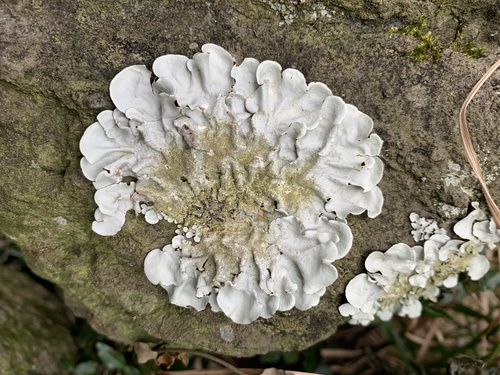
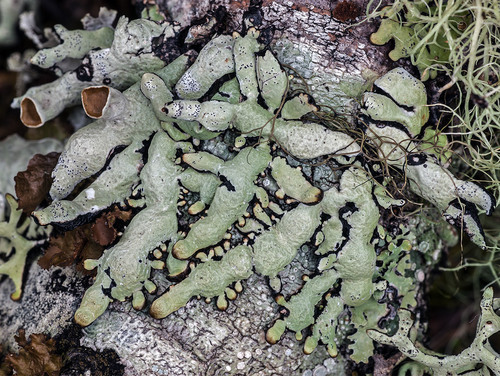
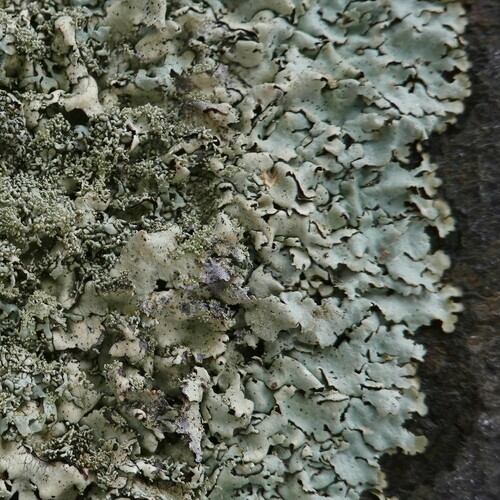
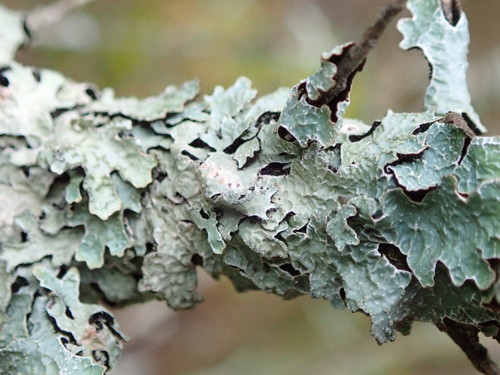
Parmelia sulcata Taylor is a foliose lichen with a generally circular thallus. The upper cortex ranges in color from glaucous white to gray, while the lower surface is black. The thallus is broadly lobed, loosely attached to its substrate, and typically reaches up to 6 cm (2+3⁄8 in) in diameter, though diameters as large as 10 cm (4 in) have been recorded. Each lobe measures between 2–5 mm (1⁄16–3⁄16 in) wide; lobes are overlapping, more or less linear, and have both marginal and laminal soralia. Elongated pseudocyphellae, which are small cortex pores, are present on both laminal and marginal regions of the lobes, and form a reticulate pattern. Rhizines on the underside of the thallus range from simple (unbranched) to squarrose (brush-like).
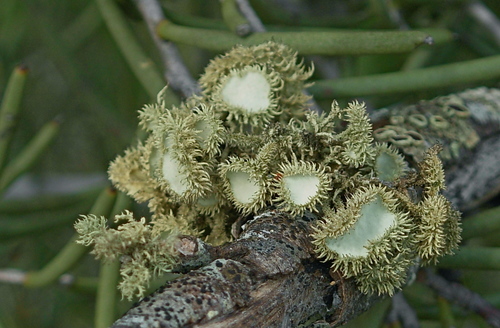
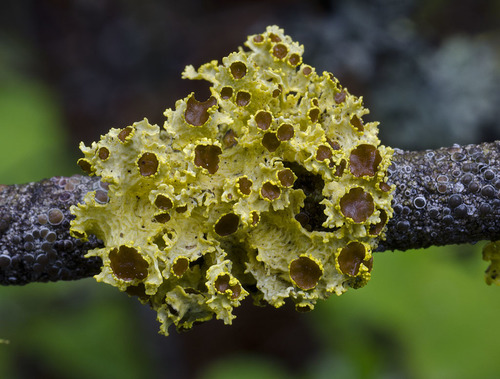
Apothecia, the fruiting bodies, are rare in this species, though they are not exceptionally rare in rural areas. When apothecia are present, they reach up to 8 mm (5⁄16 in) in diameter, are lecanorine in form, and have a red-brown disc; they often have a sorediate margin. Reproduction in P. sulcata occurs predominantly asexually through soredia. Ascospores measure 8–14 μm.
In standard spot tests, the upper surface of Parmelia sulcata reacts K+ (yellow), KC−, C−, and P−, which indicates the presence of the secondary lichen metabolites atranorin and chloroatranorin. The lichen's medulla and soredia are K+ (red-orange) and Pd+ (orange). The lichen does not fluoresce under ultraviolet light. Salazinic acid and consalazinic acid are present in the medulla; lobaric acid is variably present.
Parmelia sulcata is a common species throughout much of the world, found from temperate to cold regions of both the Northern and Southern Hemispheres. Its northern North American distribution has been described as "extremely widespread, even weedy", and includes Mexico's Baja California. It is one of the most common parmelioid lichens in Europe, having been recorded in 43 countries across the continent. It has been found to reappear in urban areas after sulfur dioxide levels have decreased. Although common in the Northern Hemisphere, Parmelia sulcata is rare in South America. A 2023 study provided molecular evidence for its presence in Chile, and showed that DNA sequences from Chile belong to the most common haplotype found in Europe, Asia, and North America, indicating a widespread distribution of this haplotype. In Africa, Parmelia sulcata has been documented from the low alpine zone in Ethiopia and Kenya, at elevations ranging from 3,500 to 4,200 m (11,500 to 13,800 ft), but it is otherwise rare on the continent.
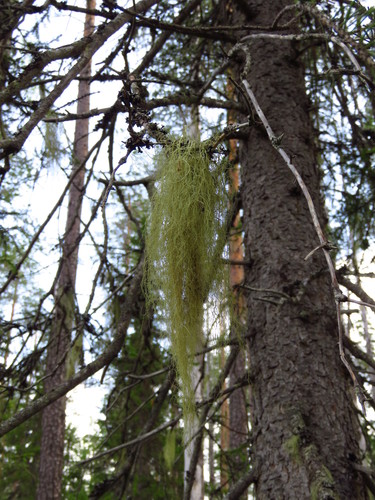
Although most common on bark and wood, Parmelia sulcata also grows on rocks or mossy rocks. In a study of epiphytic lichen distribution along tree trunks in a temperate continental climate, Parmelia sulcata was found to be most abundant in the middle to upper parts of tree trunks, particularly in areas with higher light levels. This distribution pattern suggests that light conditions are a significant factor influencing the growth and distribution of Parmelia sulcata.
The vertical zonation of Parmelia sulcata along tree trunks is influenced by various microclimatic conditions such as humidity, light conditions, and the chemical and physical properties of the bark. Parmelia sulcata, along with other lichen species, contributes to the high diversity of lichen biota in the lower and upper parts of tree trunks. The species composition of lichens, including Parmelia sulcata, changes from the base to the crown of trees, indicating the importance of light conditions in their distribution. For instance, in a Russian study, Parmelia sulcata was commonly found at heights of 10–20 m (33–66 ft) on birch trees and around 15 m (49 ft) in the crown on spruce trees, reflecting its preference for higher insolation levels, which are areas that receive more sunlight or solar radiation, in these zones.
A study conducted in a temperate deciduous forest of Central Italy monitored carbon dioxide (CO2) gas exchange, radial growth, chlorophyll content, and photobiont density of Parmelia sulcata over a year. The results showed significant seasonal variations, with CO2 gas exchange and radial growth peaking in December, and photoinhibition occurring in early spring before tree leaves sprouted. Photobiont density was highest in June and December and lowest in April. These findings suggest that the seasonal acclimation of lichen photosynthesis and chlorophyll content is influenced by variations in photobiont population density, potentially related to changes in nutrient availability.
Lichenoconium edgewoodense and Nanostictis caucasica are two species of lichenicolous, or lichen-dwelling, fungi that have been recorded exclusively parasitising Parmelia barrenoae, although Parmelia sulcata is also susceptible to other species of parasitic fungi that more broadly target the genus Parmelia, such as Arthophacopsis parmeliarum or Abrothallus parmeliarum. Another fungus that appears to be obligately parasitic on P. sulcata, Perigrapha superveniens, causes the formation of irregularly shaped to undulate, wavy edged, galls, and prefers its host to live in oceanic areas.
In traditional medicine in Canada, the Métis peoples rubbed Parmelia sulcata on the gums of teething babies, while the Saanich peoples used it as a folk medicine.