About Parkinsonia aculeata L.
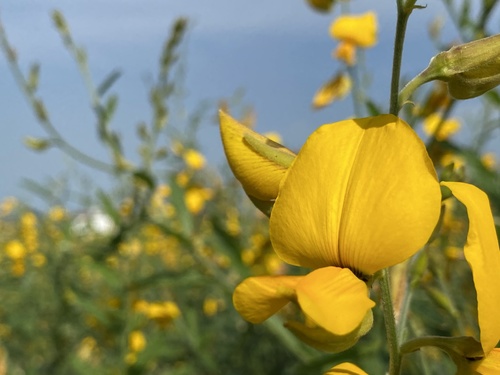
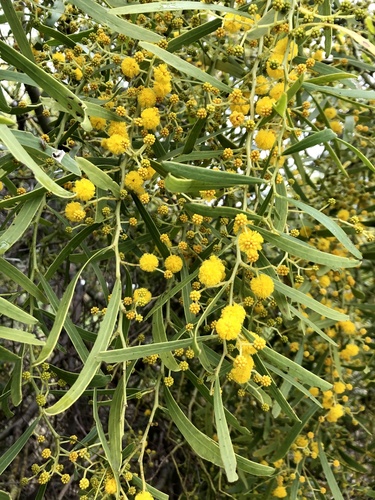
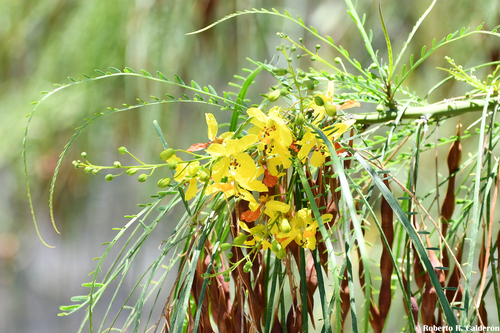
Parkinsonia aculeata can grow as either a spiny shrub or a small tree. It reaches a height of 2 to 8 m (6.6 to 26.2 ft), with a maximum recorded height of 10 metres (33 ft). This species, also commonly called palo verde, can grow with a single stem or multiple stems, and produces many branches bearing pendulous leaves. Both leaves and stems are hairless. Leaves are alternately arranged and pennate, measuring 15 to 20 cm long. The flattened petiole bears two rows of 25–30 tiny oval leaflets; these leaflets are shed quickly during dry weather, and also during winter in some regions, leaving the green petioles and branches to carry out photosynthesis. Branches produce double or triple sharp spines 7–12 mm (0.28–0.47 in) long at the leaf axils. The flowers are yellow-orange, fragrant, and 20 mm (0.79 in) in diameter. They grow in groups of eight to ten from a long, slender stalk. Each flower has five sepals and five petals: four petals are clearer in color and rhomboid ovate, while the fifth petal is elongated, with a warmer yellow tone and purple spots at its base. Flowering occurs in the middle months of spring, which falls between March and April or September and October depending on location. Flowers are pollinated by bees. The fruit is a leathery seedpod that turns light brown when it reaches maturity. P. aculeata is native to the southwestern United States and northern Mexico, with its native range extending south to the Galapagos Islands and northern Argentina. It has been introduced to Africa, Australia, India, Pakistan, and Spain. This species has a high tolerance to drought, and simply grows to a shorter stature under drought conditions. In moist, humus-rich environments, it grows into a taller, spreading shade tree. It prefers full sun exposure, but can grow on a wide range of dry soils including sand dunes, clay, and alkaline and chalky soils. It grows at altitudes ranging from 0 to 1,500 metres (0 to 4,921 ft) above sea level. In Mexico, the leaves are steeped to prepare a traditional medicine used to treat fever and epilepsy. Livestock seldom browse the plant's foliage due to its spines.