About Parkia pendula (Willd.) Benth. ex Walp.
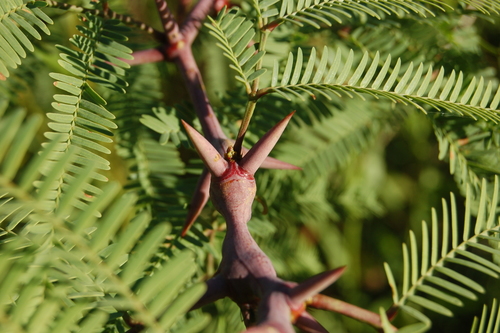
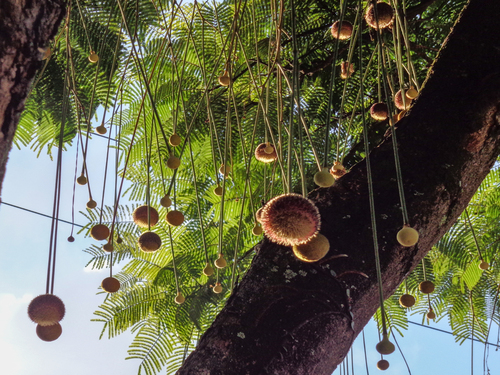
Parkia pendula (Willd.) Benth. ex Walp. is a tree species that reaches 15 to 50 meters in height and up to 1.2 meters in trunk diameter. Its plated bark is either whitish-grey or reddish-brown, and marked with many lenticels. Blooming Parkia pendula trees produce a strong, fruity floral aroma that comes from monoterpenes in the flowers, specifically the stereoisomers (Z) β-ocimene and (E) β-ocimene. Unlike other Parkia species, Parkia pendula has a flattened, layered leaf crown. Horizontal branches hold alternating bipinnate leaves arranged in 15 to 27 pairs along the branch, with up to 3 leaves growing in a whorl at a single node. Individual leaflets are dark green and oblong, with curved distal ends. Parkia pendula grows in primary and secondary forests at altitudes between 20 and 500 meters above sea level. It prefers well-drained subtropical environments, and thrives best on hills or slopes with a 30% incline that receive over 4000 mm of annual precipitation. It commonly grows alongside Peltogyne purpurea, Caryocar costaricense, and Qualea paraensis. Mature Parkia pendula trees have very high flood tolerance, and can withstand long-term submersion. However, young seedlings can only survive a few weeks in flooded conditions, which limits the range of environments where the species can successfully establish. This species is distributed across Bolivia, Brazil, Colombia, Costa Rica, French Guiana, Guyana, Honduras, Nicaragua, Peru, Suriname, and Venezuela. It grows in many lowland forests, with a large population reserve located in a national park in Espirito Santo, Brazil. Parkia pendula undergoes mass flowering, where 150 to 200 capitula typically bloom within a single night. Flowers open sequentially from the base to the tip of the capitulum. The capitula are bright red from the color of their anthers and filaments, turn yellow-red at dusk when they produce nectar and pollen, and shift to a purple-red hue when the styles elongate, completing this full color change in one night. Flowers are usually shed 3 to 4 days after blooming. Like other members of the Mimosoideae subfamily, Parkia pendula produces aggregated pollen in structures called polyads. Unlike other Mimosoideae, which have flattened polyads formed by layered pollen grains, Parkia pendula has globose polyads. Its polyads are around 100 mm in diameter, made up of 32 pollen grains, and have a grooved outer exine. Each fertile flower's stigma only holds space for a single polyad, but because the number of pollen grains in one polyad matches the number of ovules in the flower, one polyad is sufficient to fertilize all of the flower's ovules. Parkia pendula is chiropterophilous, meaning it is primarily pollinated by bats. While a dozen different bat species have been observed pollinating this species, the most common pollinator is Phyllastomus discolor. Bats are attracted by the large volume of nectar produced by the nectariferous flowers. When bats land upside-down on the flowers, large amounts of pollen accumulate on the underside of their feet and are carried to other flowers. Some bat species, such as Glossophaga soricina, do not land on the flowers and so do not contribute to pollination. The corolla plays an important role in pollination: its round shape and exposed arrangement let bats locate it via echolocation. While most bat-pollinated plants emit a sulfur scent, Parkia pendula flowers contain no sulfur compounds, which further supports that bats locate this species through echolocation. Additional recorded pollinators include opossums, kinkajous, porcupines, ring-tailed coatis, certain primates, and occasionally bees. The wood of Parkia pendula is moderately heavy, with a density of 0.57 g/cm³. Processed wood is generally white or yellow, with a thick, textured grain. It is resistant to fungal infections and porous enough to accept preservatives, so it is commonly used for furniture and carpentry. Due to its fast growth rate, ability to attract wild animals, and high nitrogen fixation capacity, Parkia pendula is well-suited for afforestation projects. It can be planted in degraded, barren areas to act as a reliable foundation for re-establishing forest. Gum from its seed pods is also notably used to catch birds. Locally, Parkia pendula is used in traditional medicine to treat dysentery, headaches, inflammation, itching, fevers, and stomach aches (with bark most commonly used for stomach aches). Research has investigated the use of Parkia pendula lectin as a histochemistry marker for distinguishing meningothelial tumors, and as a treatment for cutaneous wounds in normal and immunocompromised mice. PPeL, the lectin purified from Parkia pendula seeds, binds to cell surface carbohydrates in oligosaccharides and glycoconjugates, and produces cytoplasmic staining that can be used to characterize different tumor cell types.