About Parkia biglobosa (Jacq.) R.Br. ex G.Don
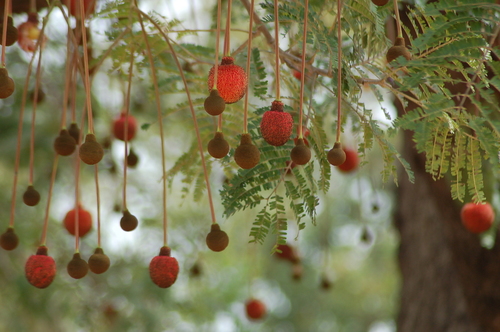
Parkia biglobosa (Jacq.) R.Br. ex G.Don is a dicotyledonous angiosperm in the Fabaceae family, part of the Caesalpinioideae subfamily’s Mimosoid clade. It is a deciduous perennial tree that reaches 7 to 20 metres in height, and may grow up to 30 metres in some cases. This tree is a fire-resistant heliophyte distinguished by its thick, dark gray-brown bark. Its pods, commonly called locust beans, start pink and turn dark brown when fully mature. On average, pods measure 30 to 40 centimetres long, and some reach roughly 45 centimetres in length. Each pod holds up to 30 seeds, which are embedded in a sweet, powdery yellow pulp. It is also known by a number of common names: arbre à farine, fern leaf, irú, monkey cutlass tree, two ball nitta-tree, nété and néré. Documented evidence of fermented locust bean use in West Africa dates back to the 14th century, and the species was described by Michel Adanson in his 1757 publication Histoire naturelle du Sénégal. Geographically, Parkia biglobosa grows in a belt that extends from Senegal’s Atlantic coast to southern Sudan and northern Uganda. It occurs across a wide range of natural communities but is most abundant in anthropic communities, areas with semi-permanent cultivation. Annual seed production in northern Nigeria is estimated at roughly 200,000 tonnes. While tree products are not common in international trade, they are an important part of local and regional trade across West Africa. Seeds are especially valued, and significant local cross-border trade occurs in the Sahel region. The naturally sweet yellow pulp that contains the seeds is processed into a valuable carbohydrate food. It is also used to make beverages. The seeds are processed into a seasoning that goes by different names among regional groups: sikomu among the Yoruba, dodowa or dawadawa among the Hausa, and sunbala in the Inner Niger Delta. Seeds are the most valuable part of the plant. They contain 29% lipids, 35% protein, and 16% carbohydrates, and serve as a good source of fat and calcium for rural people. To prepare seeds, they are first cooked to remove the seed coat, then fermented to reach the desired result. After fermentation, seeds can be pounded into powder and formed into cakes. One study on dawadawa fermentation found that Gmelina arborea and banana leaves speed up seed fermentation, while also increasing fat, protein, and moisture content and decreasing carbohydrate content. In West Africa, the bark, roots, leaves, flowers, fruits, and seeds of this tree are widely used in traditional medicine to treat a wide variety of health complaints, taken internally or applied externally, sometimes in combination with other medicinal plants. Bark is the most commonly used part for medicine, followed by leaves. Traditional medicinal applications include treatment of parasitic infections, circulatory system disorders such as arterial hypertension, and disorders of the respiratory system, digestive system, and skin. In veterinary medicine, a root decoction is used to treat coccidiosis in poultry. Green pods are crushed and added to rivers to kill fish. Multiple surveys of African indigenous healers confirm its common medicinal use: in a Togo healer survey, Parkia biglobosa was one of the most frequently cited plants for treating hypertension; in south-western Nigeria, it is one of two plants recorded as having effective wound-healing properties, with a significant effect on dermal fibroblast proliferation; and in a Guinea survey of antimalarial plant use, it was among the most frequently reported successfully used species. One analysis of the plant’s antibacterial properties found these properties compare favorably with those of streptomycin, suggesting it could be a potential source of compounds for managing bacterial infections.