About Parkesia noveboracensis (J.F.Gmelin, 1789)
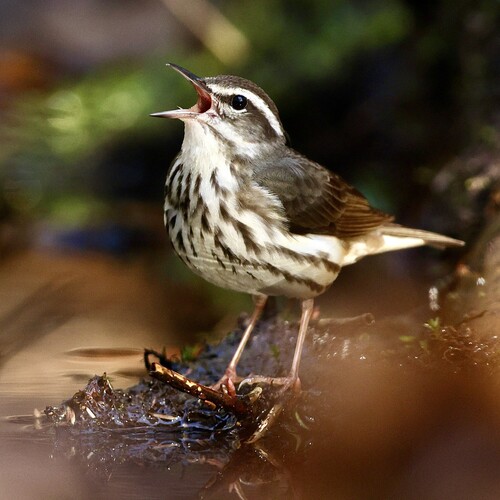
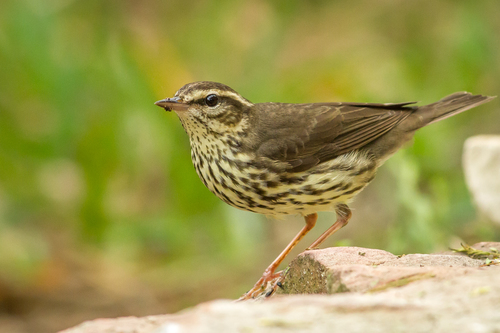
The northern waterthrush, scientifically named Parkesia noveboracensis, is a large New World warbler, despite its common name it is not a thrush. It measures 12–15 cm (4.7–5.9 in) in length, has a wingspan of 21–24 cm (8.3–9.4 in), and weighs between 13 and 25 g (0.46 and 0.88 oz). Its standard measurements are as follows: wing chord 6.8 to 8.2 cm (2.7 to 3.2 in), tail 4.5 to 5.7 cm (1.8 to 2.2 in), bill 1.1 to 1.2 cm (0.43 to 0.47 in), and tarsus 1.9 to 2.3 cm (0.75 to 0.91 in). For its appearance, the crown is brown with a white supercilium on the head, the bill is pointed and dark. The throat is lightly streaked brown to black, with heavier streaking extending onto the breast and flanks. The back is evenly brown. The sexes are morphologically similar, while young birds have buff underparts rather than white. Its song consists of loud, emphatic, clear chirping notes that generally fall in pitch and accelerate; notes are loosely paired or tripled, with very little variation. Its common call is a loud, hard spwik that rises with a strong K sound, and its flight call is a buzzy, high, slightly rising zzip. This species can be visually confused with its close relative the Louisiana waterthrush (Parkesia motacilla). Louisiana waterthrushes have buff flanks, a buff undertail, bright pink legs, a whiter throat with fewer streaks. More subtle differences that distinguish Louisiana waterthrush include smaller size and smaller bill, a narrower darker eye-line, and different call notes and habits. Both waterthrush species walk instead of hopping, and appear to teeter as they move, because they bob their rear ends while traveling. In terms of distribution and habitat, northern waterthrush breeding territories occur across both upland and riparian habitats, but the species occupies harvested areas only rarely. Northern waterthrushes crowded into riparian buffer zones adjacent to harvested areas have more difficulty foraging than individuals in untouched areas. On Puerto Rican wintering grounds, northern waterthrushes leave daytime foraging areas and fly up to 2 km (1.2 mi) to reach nighttime roosts, which are most often located in red mangrove habitats. In Puerto Rico, northern waterthrushes winter in four main habitat types: white mangrove, red mangrove, black mangrove, and scrub. Males, which are larger and migrate earlier in spring, prefer to winter in white mangrove, and are able to maintain or gain weight over the winter. Females winter in the other drier, less food-rich habitat types. During the non-breeding period, northern waterthrushes are site-faithful and tend to be solitary. The northern waterthrush is a terrestrial ground feeder. It eats insects, spiders, mollusks such as snails, worms, and crustaceans found in leaf litter, as well as minnows, which it catches while wading through water.