About Parkesia motacilla (Vieillot, 1809)
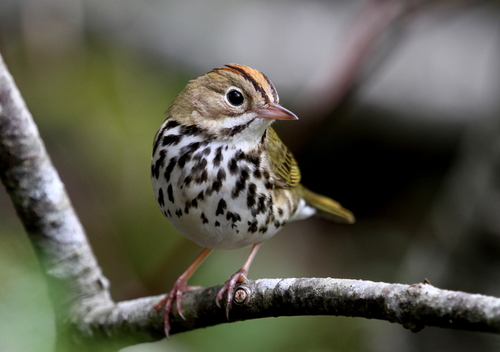
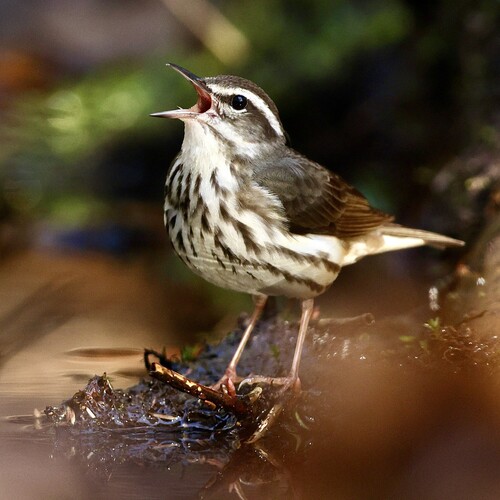
The Louisiana waterthrush (Parkesia motacilla) has a plain brown back and black-streaked white underparts, with buff-colored flanks and undertail. It features a prominent, wide flared white supercilium, and bright pink legs. All plumages look similar, except young birds have buff underparts instead of white. The species most easily confused with it is its close relative the northern waterthrush (Parkesia noveboracensis), which has white flanks and undertail, a striped throat, a slightly smaller bill, a shorter supercilium, and duller pink legs. A study of the two species on Connecticut nesting grounds found the average weight of Louisiana waterthrush was 20.6 g (0.73 oz), making it noticeably larger than the northern waterthrush, which averaged 16.2 g (0.57 oz). The Louisiana waterthrush is the largest species of wood warbler. Its total body length ranges from 14–17 cm (5.5–6.7 in), and its wingspan spans 21–25.4 cm (8.3–10.0 in). Adult weights can vary from 17.4 to 28 g (0.61 to 0.99 oz). Standard measurements are as follows: wing chord 7.4 to 8.5 cm (2.9 to 3.3 in), tail 4.4 to 5.4 cm (1.7 to 2.1 in), bill 1.2 to 1.5 cm (0.47 to 0.59 in), and tarsus 2 to 2.3 cm (0.79 to 0.91 in). The male's song is a distinctive musical sequence of descending notes, followed by a warble. The starting notes of the Louisiana waterthrush's song usually decrease in pitch, matching the sloped hilly streams it prefers as habitat; the northern waterthrush's song shows far less pitch variation. The Louisiana waterthrush's call is a hard chink. Like its close relative the northern waterthrush, the Louisiana waterthrush frequently bobs its tail. The Louisiana waterthrush breeds in eastern North America, from the southernmost part of Canada south through the eastern United States, excluding Florida and the coast. It is a migratory species, wintering in Central America and the West Indies. It is a rare vagrant to the western United States. It is one of the earliest neotropical migrants to return to spring breeding grounds, often finishing its migration in late March or early April, almost two months earlier than most other warblers arrive. It is also one of the earliest warblers to leave breeding grounds: some individuals depart as early as July, and almost all have left by late August. Male Louisiana waterthrush do not sing on their wintering grounds before departing, and begin singing immediately after arriving on their breeding territory. It is unknown whether they start singing during migration. When establishing a territory, a male sings vigorously almost all day. After mating, his singing frequency drops quickly, and he only sings concentrated in the morning hours. The breeding habitat of the Louisiana waterthrush is wet woodland near running water, and it does not breed outside this type of area. During winter, however, the species mainly forages along flooded roads or trails, and in parks, lawns, and gardens, and rarely enters true forest—even forested wetlands—in the subtropics. The northern waterthrush prefers stagnant, swampy waters and is generally a more terrestrial forager. Louisiana waterthrushes prefer dense vegetation along the water's edge for nesting, as this provides the main protection for the nest from predation. They nest in rock crevices, on mud banks, or among tree roots. They build a cup nest and lay 4–6 eggs from late May to mid-June. Both parents work together to construct the nest, which is built from wet, muddy leaves, pine needles, grass, and small twigs. The female incubates the eggs for 12 or 13 days. Young fledge 9 or 10 days after hatching, and both adults continue to feed the young for an additional 4 weeks. The Louisiana waterthrush is one of the few passerine species that does most of its foraging in actively running water, a trait shared at the family level only by dippers. Its diet mostly consists of aquatic insects, molluscs, and crustaceans. It occasionally takes ground-based insects such as beetles and ants, as well as flying insects such as flies, which it may catch mid-flight. It can also forage among leaf litter. When insect prey is scarce, Louisiana waterthrushes may hunt larger prey including salamanders and small fish.