About Parietaria judaica L.
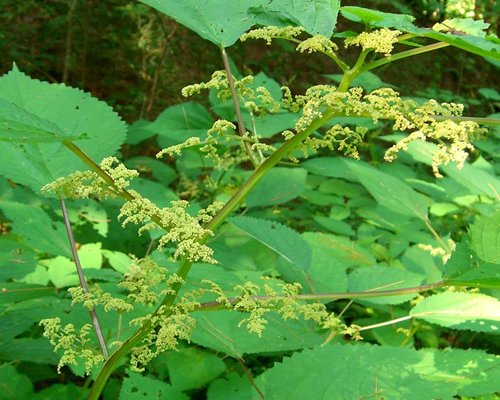
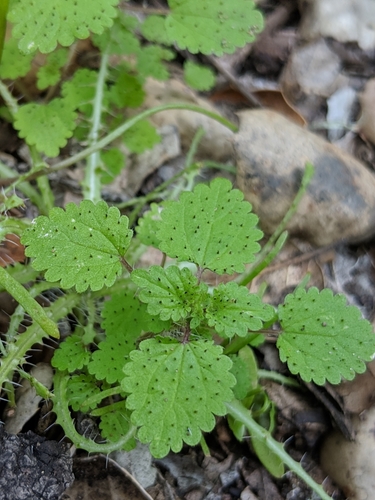
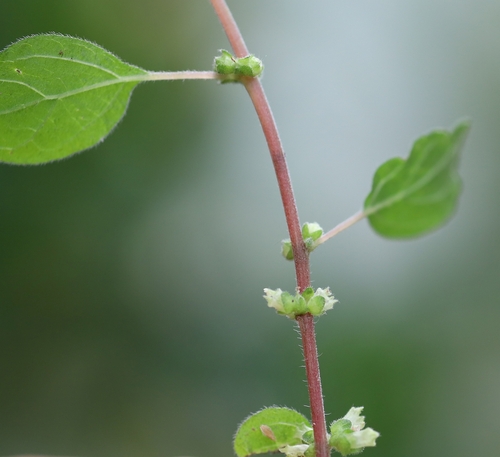
Spreading pellitory (Parietaria judaica L.) is a perennial herb that reaches about 50 cm in height, with a maximum height of 110 cm. It has an upright to sprawling, untidy growth habit, with many branched stems that are pink or red, and slightly woody, brittle at the base. Its leaves are arranged alternately, and are oval-lanceolate in shape. Most leaves measure 3 cm long by 1.5 cm wide, though they can exceptionally grow up to 6 cm long and 3 cm wide. Each leaf has a petiole roughly half as long as its leaf blade. Soft hairs cover the lower leaf veins, leaf margins, and petioles; the upper leaf surface is often glossy, either hairless or with scattered hairs, and has sunken veins. In suitable conditions in Europe, this species can flower year-round. Its inflorescences form clusters in leaf axils, with each cluster holding 3 to 8 white or pink flowers subtended by tiny bracts. Typically, one flower in each cluster is female-only, and the remaining 2 to 7 are hermaphroditic, though female flowers are less common in the eastern part of the species' range. Female flowers have 4 perianth segments, and reach 2 mm in diameter when in fruit. Hermaphroditic flowers are tubular, up to 3 mm across when in fruit, with 4 to 5 stamens that mature first, and a single stigma that develops later. When a hermaphroditic flower first opens, the stamen filaments are elastic enough to spring outward suddenly, dispersing pollen ballistically from the anthers. The fruits are blackish achenes, and often fall while still attached to the perianth, which bears minute hooked hairs that create the 'stickiness' the plant is well known for. Spreading pellitory is a fairly distinctive plant. Where their ranges overlap, for example in the eastern Mediterranean, it is most likely to be confused with upright pellitory, Parietaria officinalis. Under normal conditions the two can be separated easily: upright pellitory has fully erect stems and larger leaves that can grow up to 12 cm long, while spreading pellitory leaves are all less than 6 cm long. For intermediate plants, examination of flower anatomy is required. Upright pellitory has larger female flowers, measuring 2.75 mm or more, compared to 2.25 mm or less for spreading pellitory; upright pellitory's female flower is also much longer than its subtending bracts, while spreading pellitory's female flower is roughly the same length as its bracts. Spreading pellitory is native to Macaronesia, North Africa, and the region extending from Europe to Central Asia and Central Himalaya. It has been introduced to parts of North America, South America, Scandinavia, and Australia. The IUCN has not yet evaluated the species' global conservation status, but it is classified as Least Concern (unthreatened) in France, Britain, and other areas, though it is rarer in some regions: for example, it is classified as Endangered (EN) in Lorraine and entirely absent from Alsace. It is a lowland species: it has been recorded from sea level up to around 125 m in California, and does not grow above 200 m anywhere in the United States. Altitudinal records are not collected for the species in Britain, but analysis of its growing regions there shows it does not occur on land over 500 m, and very little grows over 300 m. In its native habitat, spreading pellitory grows on rocks and bare ground in slightly damp, sheltered locations such as seasonal river valleys in limestone areas of the Eastern Mediterranean. It is well adapted to synanthropic habitats in towns, and can exploit the urban heat island effect to thrive in colder climates. It has become common in other introduced continents, where it benefits from competitive release from its native pests and predators. In urban landscapes, its main habitat is at the base of walls, where conditions have increased dampness, light shade, and protection from trampling. It grows on bare soil or in gaps at the edge of pavements, and is tolerant of light salinity, so it can grow in coastal towns and beside roads treated with de-icing salt. It can also be found in gaps in mortar between bricks or stones of older or damp walls, on shingle, and at the base of hedges. Plant density is highest in old town centres, and decreases in suburbs until the species is virtually absent from open countryside, which is presumably because it is highly palatable to livestock. It grows in conditions that few other plants can tolerate, so it is found in very species-poor communities, often with no other associated plant species at all. In sheltered locations, spreading pellitory is an evergreen that typically produces smaller leaves to survive winter (in the north of its range) or summer (in warmer countries); in less hospitable sites, it dies back to a dense tangle of woody stems. While it can flower at any time of year, its main flowering seasons are autumn and spring in the Mediterranean region, and summer in northern Europe. Flowering is strongly affected by aspect (it flowers more on south-facing walls in the northern hemisphere), temperature (best in warmer countries), and climate change (it flowers more in a warming environment). The British National Vegetation Classification classifies Parietaria diffusa (a synonym of P. judaica) as belonging to its own phytosociological community, OV41, which occurs on walls or coastal cliffs. The OV41a wall community is rather species-poor, with typically only around 7 other plant species present in a sample; the most common associates are the mosses Homalothecium sericeum and Tortula muralis. The OV41b coastal community, by contrast, has an average of 17 species per sample, including red fescue and wild carrot, and can also host several rare species such as wild cabbage. In continental Europe, the Parietanetalia community of old city walls, which includes spreading pellitory, is considered an important refuge for endangered species. Spreading pellitory is tolerant of high levels of traffic-related heavy metal pollution in urban environments. Heavy metals including lead, cadmium, copper, and zinc accumulate in its tissues, and this accumulation has been shown to cause increased pollen production. Its Ellenberg values in central Europe are L = 6, F = 7, R = 8, N = 7, and S = 1, which indicates it favours damp, reasonably sunny sites on slightly alkaline, fertile soils, and can grow in slightly brackish situations. This species is wind-pollinated. Its seeds are adhesive, and are dispersed by insects, other animals, people, and machines. The larvae of the red admiral butterfly (Vanessa atalanta) and the Bloxworth snout moth (Hypena obsitalis) feed on pellitories including spreading pellitory, as do several aphid species, most notably Aphis parietariae. The pollen of spreading pellitory is one of the leading causes of respiratory allergies (asthma and rhinitis) in the Mediterranean region, particularly during peak flowering in spring and autumn. One study estimated that a large population of pellitory in a Greek city could produce as many as 5.4 billion pollen grains per square metre during spring, causing many medical issues. It has been established in Australia since 1902 or earlier, especially in Sydney, Melbourne, and Fremantle, where it is classified as a noxious weed. It is controlled with glyphosate applications, though it can regrow quickly from the persistent soil seed bank. In herbal medicine, spreading pellitory was thought to be effective against kidney and bladder stones, likely because its roots appear to split stone walls. Early 20th century celebrated herbalist Maud Grieve stated that its "action upon the urinary calculus is perhaps more marked than any other simple agent at present employed". Some Romani groups use it to treat sores, ulcers, and piles. Some authors identify the plant listed as Helxine by Ancient Greek herbalist Dioscorides as spreading pellitory. Dioscorides' description matches well: "helxine grows in mounds and walls. It has thin little stalks, somewhat red, rough leaves similar to mercury; and around the stalks (as it were) sharp little seeds, catching hold of cloths." He considered it useful against all types of inflammation and oedema, and for many other purposes. Fifteen hundred years later, English herbalist Nicholas Culpeper published a similar description that included some errors such as a claim that it has opposite leaves, and classified it as a useful antidiuretic and general cure-all.