About Pardirallus nigricans (Vieillot, 1819)
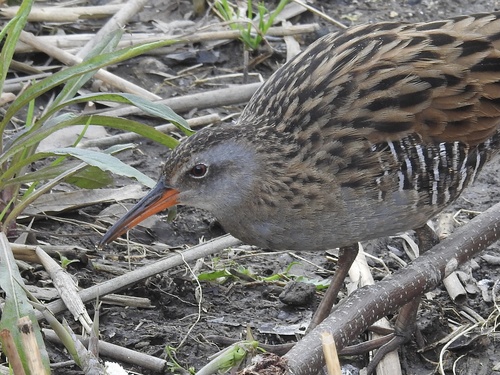
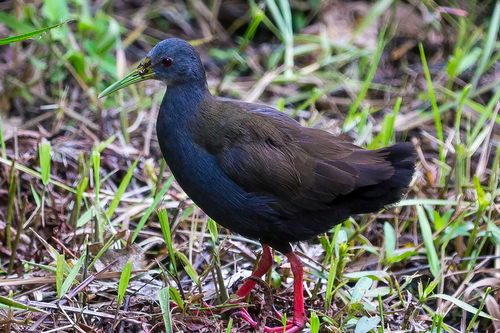
The blackish rail (Pardirallus nigricans) measures 27 to 29 cm (11 to 11 inches) in length; one recorded male weighed 217 g (7.7 oz). The species has no visible sexual dimorphism, meaning males and females look identical. All individuals have a long yellow-green bill and pinkish legs. The nominate subspecies has unmarked dark brown upperparts, a white chin and throat, and dark gray face and underparts. Subspecies P. n. caucae is larger than the nominate, with a larger whiter throat patch and paler underparts, particularly on the vent area.
This species has a disjunct, split range across South America. The nominate subspecies is split into two separate populations: one ranges from northeastern Brazil south and west to southeastern Brazil, northern Argentina, and eastern Paraguay; the other forms a rough crescent shape from western Brazil through central Peru and Ecuador almost to the Colombian border. There are unconfirmed sight records of the blackish rail in Bolivia, so the South American Classification Committee of the American Ornithological Society classifies it as a hypothetical species there. Subspecies P. n. caucae is found only in central Colombia, and is named for the Cauca River. The species has also been documented in western Venezuela, but it is not yet known if these individuals belong to P. n. caucae or an as-yet undescribed subspecies.
The blackish rail lives in wetland habitats, including marshes, heavily vegetated waterways, rice fields, wet grasslands, and lightly wooded swamps. It mostly occurs in lowland areas, but in the Andes it can be found between 800 and 2,200 m (2,600 and 7,200 ft) above sea level, and there is one documented record of the species at approximately 4,100 m (13,500 ft) in Peru.