About Parawixia bistriata (Rengger, 1836)
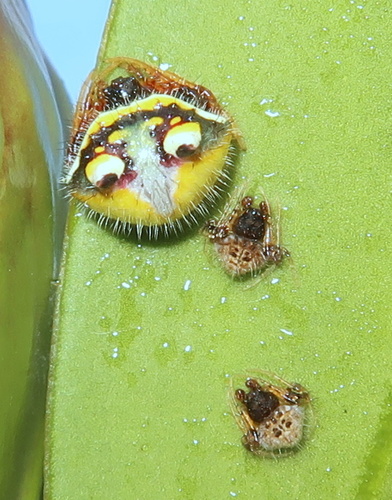
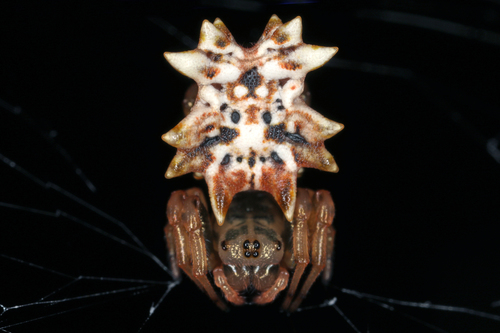
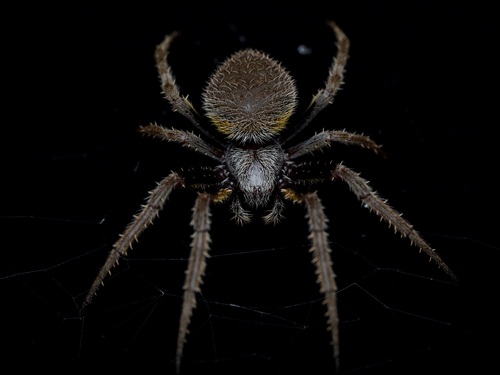
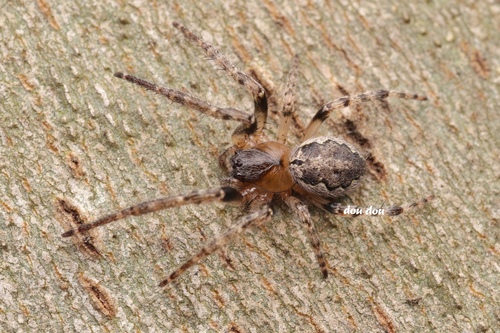
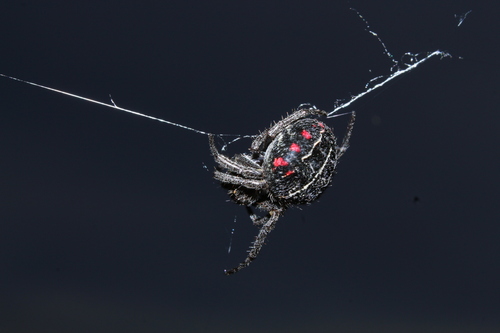
Parawixia bistriata (Rengger, 1836) has a body that is mainly black in color. Some individuals have small red dots around the abdomen. Its legs are short and also black. The eyes are very small, and are almost invisible on its black head. The abdomen is noticeably large relative to the rest of its body. This species lives in clusters, so groups of them can be easily spotted within their shared web system. To an observer, these clusters look like large black clouds on trees and other structures. Parawixia bistriata is widely distributed across South America, including Argentina, in regions that are generally warm and humid. It can tolerate a wide range of habitat types, both dry and wet. Its group foraging behavior adapts to the availability of local resources, which makes this species an excellent subject for studying the effects of food shortage stress. In Argentina, the climate has a distinct division between dry and rainy seasons, with dry winters and wet summers. Field observations show that Parawixia bistriata experiences food shortages during the dry season. Group feeding behavior allows developing juveniles to obtain more food.