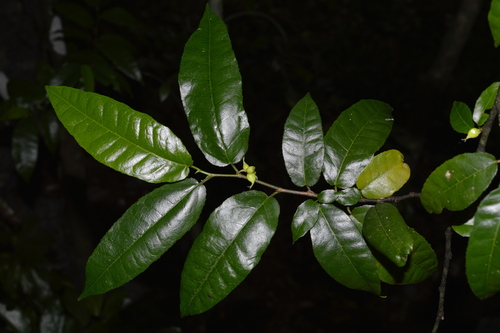
About Paratrophis pendulina (Endl.) E.M.Gardner
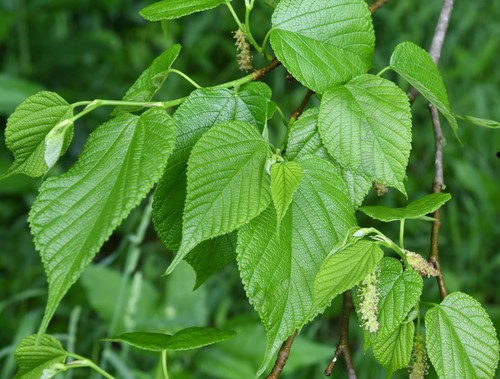
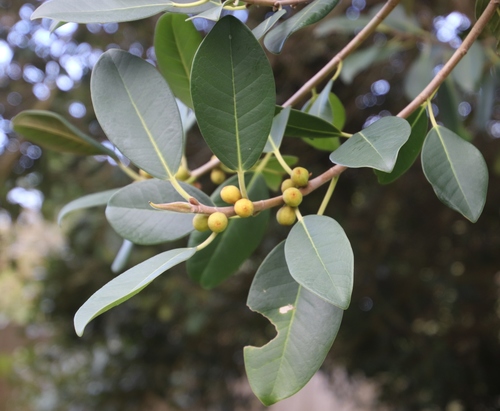
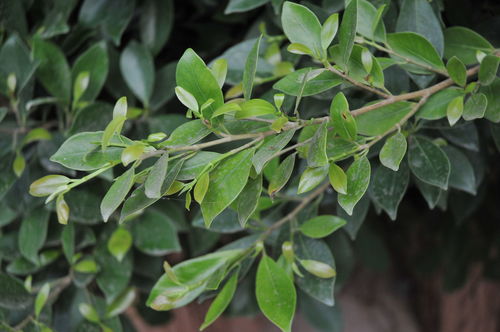
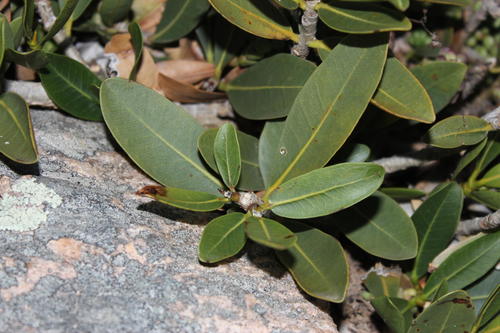
Paratrophis pendulina (Endl.) E.M.Gardner is typically a large shrub or small tree; it rarely grows into a large tree reaching 30 metres (98 feet) in height with a trunk diameter of 40 centimetres (16 inches). Its trunk is mostly cylindrical or flanged, and its brown bark has lines of vertical pustules. The leaves are thin, alternate, simple, 5 to 8 cm (2 to 3+1⁄4 inches) long, and end in a long pointed tip. Leaves are usually finely toothed; the upper surface is glossy and mid green, while the underside is hairy. Leaf venation is more visible on the leaf underside, and unlike in related species, the lateral veins do not end in the leaf serrations. Flowering occurs between September and May: male flowers grow on spikes, while female flowers grow in small clusters or on spikes. The fruit, a yellow berry 4 to 6 millimetres (1⁄8 to 1⁄4 inches) long, matures from January to May. The seeds are round, pale in colour, and 3 mm in diameter. In Australia, this species is found east of the Great Dividing Range, ranging from near Milton (35° S) in the southern Illawarra district of New South Wales to Cape York Peninsula at the northern tip of Australia. It commonly grows in multiple types of tropical, subtropical, and warm-temperate rainforest, and is particularly found growing alongside streams. Germination from fresh seed occurs easily within seven weeks. The fruit is eaten by a variety of birds, including the brown cuckoo dove, green catbird, Lewin's honeyeater, rose crowned fruit dove, and topknot pigeon. In Hawaii, Paratrophis pendulina grows in dry forests, coastal mesic forests, mixed mesic forests, and wet forests, at elevations from sea level up to 1,675 m (5,495 ft).