About Paratrigona subnuda Moure, 1947
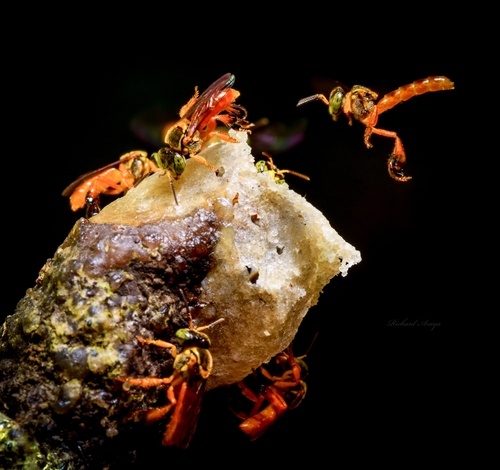
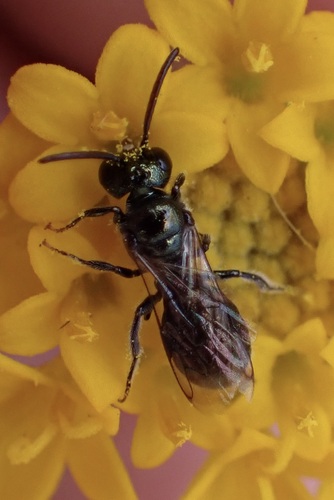
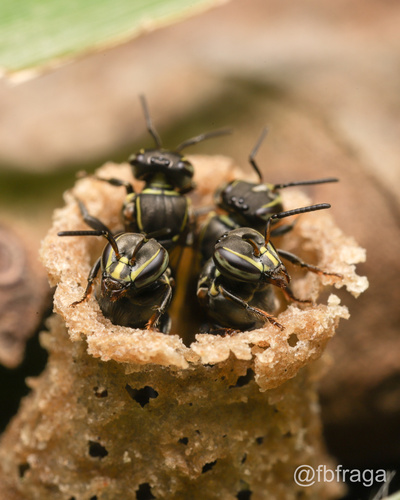
Morphologically, Paratrigona subnuda bees have all the characteristic features of the Meliponini tribe. These features include reduced wing venation, a brush of stiff setae called a penicillum on the anterior portion of the hind tibia, and a reduced stinger. As a member of the Meliponini tribe, P. subnuda also has distinct dorsal vessel phenotypes: the dorsal vessels form an arch between the longitudinal muscles of the thorax, which causes the abdominal ganglia to shift forward and the digestive tract to become extended. In general, members of the Meliponini tribe typically have denser hair coverage, shorter wings, and larger body sizes than members of the Trigonini tribe. There is a very clear size difference between P. subnuda queens and workers. P. subnuda workers measure 0.5-0.8 cm in size, and have smaller heads and thoraxes than queens. A physogastric queen, which has a swollen abdomen, is roughly double the size of a worker, measuring 1.2-1.8 cm. Compared to other Neotropical bees, P. subnuda is considered small, and this small body size is what distinguishes it within the Meliponini tribe. P. subnuda is found in Neotropical moist forests and urban areas across South America. Its distribution overlaps with the ranges of many other stingless bee species, and has particularly large overlap with the distribution of Tetragonisca angustula. It has been studied in the Brazilian states of Minas Gerais, Paraná, Rio de Janeiro, Rio Grande do Sul, Santa Catarina, and São Paulo, and also occurs in south to eastern regions of Central Brazil. P. subnuda nests in the soft, moist soil of these Neotropical environments, and the species is considered common in Brazilian Neotropical habitats. For colony reproduction, virgin daughter queens called gynes leave the original colony to found a new colony, in part because the original physogastric queen is too immobile to swarm to the new colony. Contact between the original mother queen and the new daughter queen can last for weeks or months. This phenomenon is a result of P. subnuda’s single-mating behavior. Single mating leads to lower conflict between daughter and mother queens, because it increases the genetic relatedness between the daughter queen and the mother queen’s offspring. When the original queen produces males, workers shift their preference to the daughter queen because they are more closely related to the new queen’s sons. Unlike many other tropical bees, stingless bee colonies only reproduce once per year, and sometimes even less frequently.