About Parathyma selenophora (Kollar, 1848)
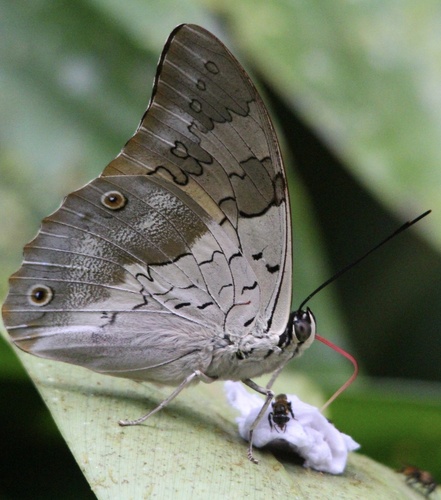
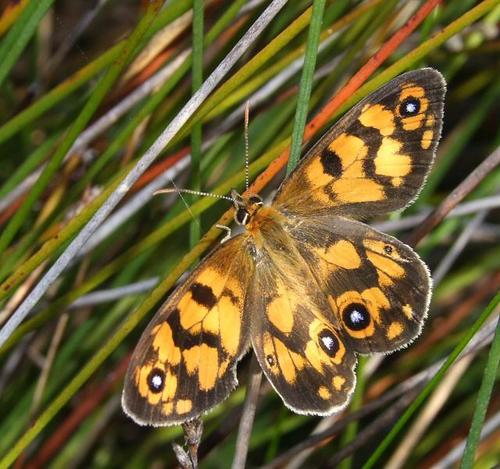
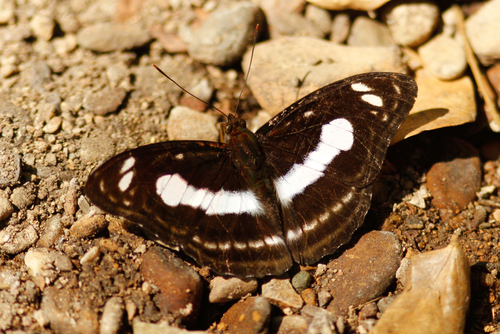
This species is scientifically named Parathyma selenophora (Kollar, 1844), commonly called the staff sergeant. For the male, the upperside of the wings is black. The forewing has a deep red discoidal streak that is twice divided, with a dusky white apical portion. Beyond this streak, three elongate oval white spots sit in the interspaces, forming a distinct white band that runs from the dorsum to interspace 3, with variable width. There is an obscure inner subterminal line of transverse whitish marks, and an even more obscure outer subterminal pale line. The hindwing has a broad white discal band that continues the forewing's band across to vein 1, along with a narrow diffuse pale postdiscal macular band and a subterminal pale line. The abdominal fold is dusky grey, and the cilia of both forewings and hindwings are black, alternating with white. The underside is bright chestnut red, with the same pattern of markings as the upperside but all markings are white, and markings become diffuse on the terminal portions of the wings. The forewing's discoidal streak is white, diffuse, and more broadly divided; interspace 8 is white at its base, with a dark chestnut-red loop below it in interspace 7 that crosses into the cellular area. Very dark postdiscal blotches are present in forewing interspaces 1a, 1 to 3; on the hindwing, a series of very dark chestnut-red marks sit between the discal and postdiscal bands. The dorsal margin of the hindwing is broadly blue. Antennae, head, thorax, and abdomen are very dark brown; on the underside, the palpi, thorax, and abdomen are white faintly tinged with blue. For the female, the upperside is velvety brownish black with white and pale markings. The forewing has a club-shaped (clavate) discoidal streak that is twice divided, plus a large elongate triangular spot beyond the apex of the cell. There is a macular discal band made of four large spots inclined outwards from the dorsum, and three obliquely placed spots starting beyond the middle of the costa. The lowest of these three spots is minute, while the next two are large and elongate, with a very slender short streak above them on the costa. There is an inner subterminal series of transverse spots and an incomplete outer subterminal pale line. On the hindwing, the subbasal broad band widens toward the costa; there is a postdiscal series of large, inwardly bluntly conical spots and a broad subterminal pale line. The female's underside matches the male's, but the white markings are broader, and the ground colour is not as bright. Antennae, thorax, and abdomen match the male's except the abdomen has a white transverse band at its base. The wingspan ranges from 66 to 76 mm. This species is found in habitats across the Himalayas, southern India including the Nilgiris and the Western Ghats, Assam, Myanmar, and northern Tenasserim. The dry-season form of this species has a brown ground colour in both sexes, with the male's ground colour paler than the female's. The discal band has variable width, but is generally broader on both the upper and undersides of the wings, and the underside ground colour is ochraceous brown. Its larva and pupa resemble those of Athyma inara Doubleday & Hewitson, but the larva has a much smaller dorsal patch and some white spots on the sides. The pupa can be distinguished from A. inara pupae by slight differences in the shape of the grotesque processes on the head and thorax. The most common food plant for this species is Adina cordifolia, as recorded by Davidson, Bell and Aitken.