About Parasola auricoma (Pat.) Redhead, Vilgalys & Hopple
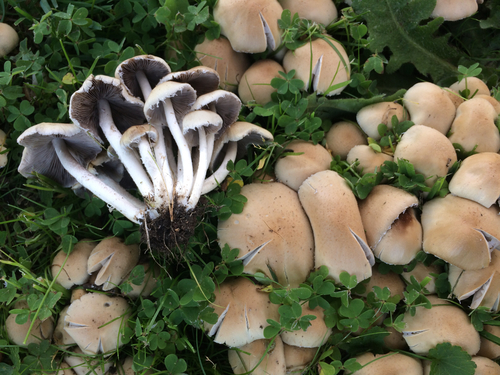
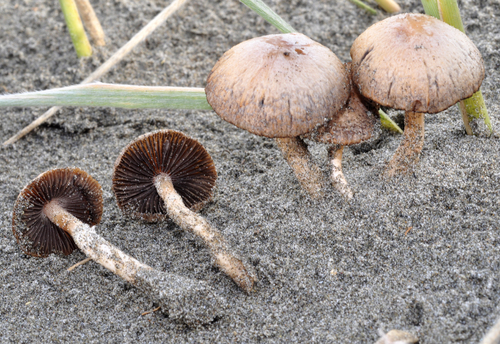
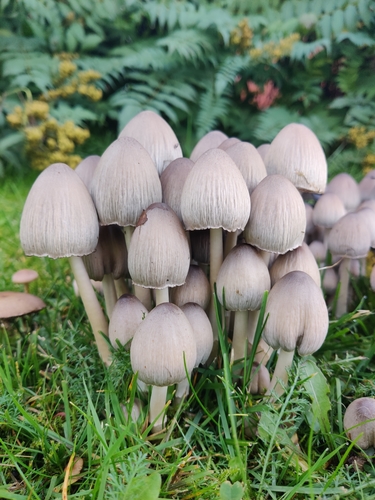
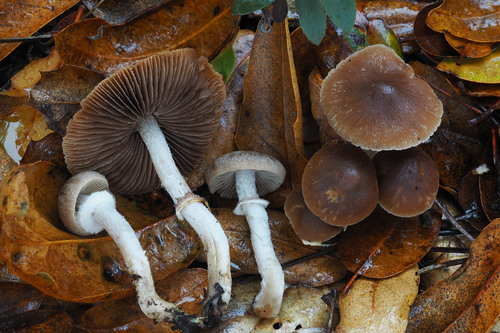
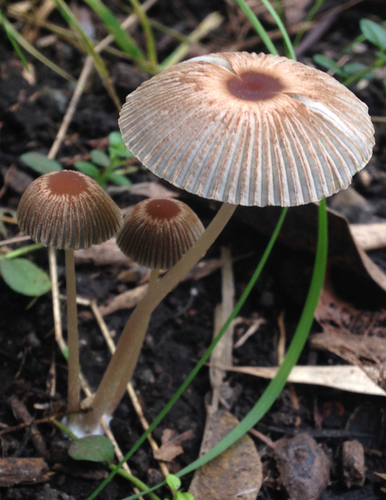
This fungus, Parasola auricoma, produces fruit bodies with caps that start out egg-shaped with inward-curled margins. As the cap expands, it becomes conical, and eventually flattens or becomes slightly depressed at the center, reaching a maximum diameter of 6 cm (2.4 in). The fruit bodies are hygrophanous, meaning their color changes depending on hydration state. Young, fresh caps are reddish brown and glisten, particularly when wet. As the mushroom matures, the outer edge of the cap turns greyish, while the center stays reddish brown. Radial grooves run from the cap's center out to its margins, and minute hairs called setae are visible on the cap when viewed with a hand lens. The gills do not attach to the stem, and are between 0.2–0.4 cm (0.08–0.16 in) wide. They start out whitish, then turn greyish brown, and finally become blackish with a dark edge as spores mature. Unlike some other coprinoid mushrooms, the gills of Parasola auricoma do not deliquesce – the process where gills dissolve into an inky black mass to release spores. The whitish stem is hollow, fragile, up to 12 cm (4.7 in) long and 0.4 cm (0.16 in) thick. Young fruit bodies often have many thick-walled hairs at the stem base, but these usually disappear as the mushroom matures. The flesh is thin, fragile, and yellowish to brownish, with no distinct noticeable odor or taste. The spore print is brownish-black. The edibility of P. auricoma is not known with certainty, and the fruit bodies are small and insubstantial. The spores are ellipsoid with a central germ pore, and measure 10–14 by 5.75–8 μm. The spore-bearing basidia are club-shaped and produce four spores each. Colorless pleurocystidia (cystidia on the gill face) measure 70–140 by 20–45 μm, and are roughly elliptical to flask-shaped. Cheilocystidia, found on the gill edge, have a similar shape and measure 50–95 by 15–25 μm. Clamp connections are present in the hyphae of all tissues of P. auricoma. The cap cuticle is made of a layer of club-shaped, thin-walled cells measuring 25–40 by 10–30 μm, interspersed with long, dark, thick-walled setae. Yellowish-brown setae are abundant on the cap surface: each has an elongated, hair-like segment up to 315 μm long, attached to the cap by a bulbous base 3–9 μm wide. Parasola auricoma is a saprobic species, meaning it gets nutrients by breaking down organic matter into simpler molecules. Its fruit bodies grow either singly or in groups, often in large numbers, alongside roads in deciduous forests or in grassy areas. The mushrooms are short-lived, usually only lasting a few hours before collapsing. It is common in Europe and North America, including Hawaii, and has also been recorded in Japan and, reported by mycologist Juan Camilo Rodríguez Martínez, in Bogotá, Colombia. In Europe, fruit bodies most commonly appear in spring and summer, while in North America, fruiting is most common in late summer and autumn after rains.