About Pararge petropolitana (Fabricius, 1787)
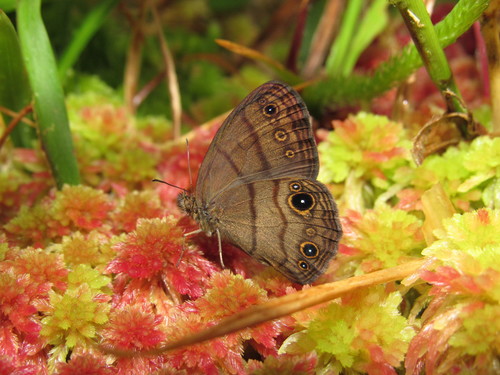
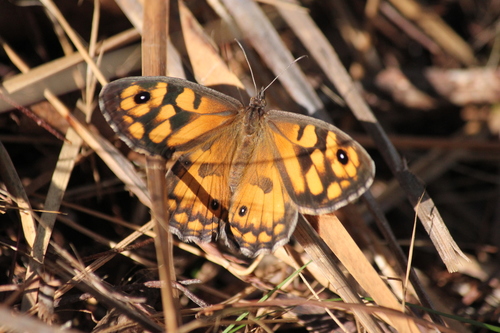
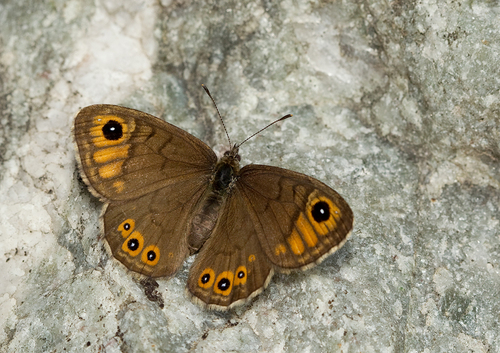
This species was described as Pararge hiera F. (45 d) in Seitz's work. Adults are very similar in upperside appearance to the related species Pararge maera, but are always black-brown, matching the color of the darkest form of maera. Their forewings are less pointed and have a straighter distal margin. On the underside of the forewing, the russet-yellow distal band does not extend uninterrupted to the anal angle, instead stopping at the lower median vein or being interrupted at that point. The apical ocellus of this species less often has a double pupil; it is most often quite circular, and it is not always accompanied by a small accessory eye-dot towards the apex, which is nearly always the case for maera. This species is usually smaller even than the smallest maera. Its black markings, which are very similar to those of maera, are visible by transparency on the fully darkened upperside. This species occurs in higher mountains of Southern Europe, including the Black Forest, Alps, Carpathians, Apennines, and the Balkans, and is also found in Asia Minor, the mountains of Central Asia, the Altai, and the Kentei Mountains. It also lives in the North, frequently in plains such as those of North Russia, Finland, Livonia, and Amurland, and also occurs in northern mountains, for example in Scandinavia. Northern specimens are generally darker and more uniformly colored, sometimes almost without markings; Neublieger named this form finmarchica. The larva is uniformly green, with a dark dorsal line that is only distinct on the posterior part of the body, and was originally recorded feeding on Festuca. Adult butterflies are on the wing in May and June in plains, and not until June and July in high mountains. They are not rare in most locations. They prefer to rest under overhanging rocks, and settle on stones and walls. Their flight is similar to that of Pararge megera and Pararge maera. There are either one or two generations annually, with adults flying from April to September. Larvae feed on various grasses, mainly Dactylis glomerata, Festuca rubra and Festuca ovina.