About Paraponera clavata (Fabricius, 1775)
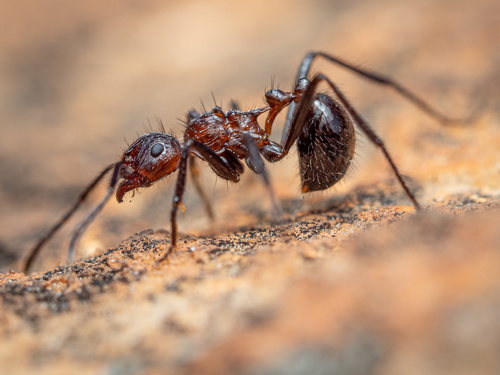
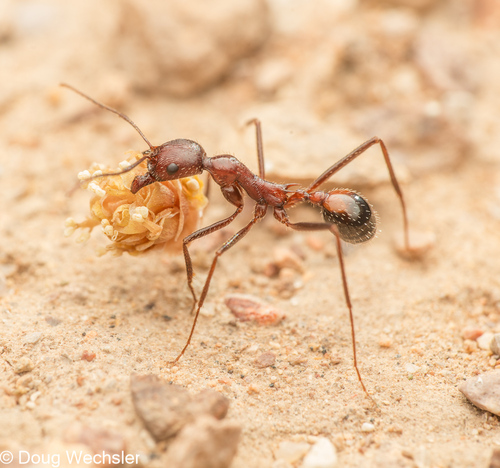
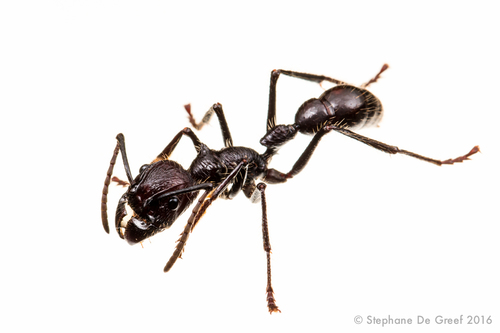
Worker Paraponera clavata ants measure 18–30 mm (0.7–1.2 in) in length, and look like thick-bodied, reddish-black wingless wasps. The Paraponera genus is predatory. Like all primitive poneromorphs, Paraponera clavata does not have size polymorphism in its worker caste, and the queen is not much larger than the workers. These ants are not generally aggressive, but they act viciously to defend their nests: they produce a stridulating sound and sting with great ferocity. Paraponera clavata is distributed across Central and South America, and is common in the wet Neotropical realm. In the north, its range includes Honduras, El Salvador, Nicaragua, Costa Rica, and Panama; in the south, it reaches Venezuela, Colombia, Ecuador, Peru, Bolivia, and Brazil. Colonies live in lowland habitats, at elevations from sea level up to 750 metres (2,461 ft), though specimens have been collected at 1,500 metres (4,921 ft) in La Amistad International Park. Colonies hold several hundred individuals, and are usually located at the bases of trees. Workers forage in trees for small arthropods and nectar in the area directly above their nest, often reaching as high as the upper canopy; very little foraging takes place on the forest floor. Nectar, carried between the ants' mandibles, is the most common food foragers bring back to the nest. Two separate studies, one in Costa Rica and one on Barro Colorado Island (BCI), found roughly four bullet ant nests per hectare of forest. On BCI, nests were found beneath 70 tree species, six shrub species, two liana species, and one palm species. Nests were most common under the canopies of Faramea occidentalis and Trichilia tuberculata, but these two tree species are also the most abundant in the forest. Nests occurred under Alseis blackiana, Tabernaemontana arborea, Virola sebifera, Guarea guidonia, and Oenocarpus mapora more often than would be expected based on how common these tree species are. The large number of different host plants suggests bullet ants do very little active selection of nest sites. Small shrubs are used less often than expected, likely because they do not provide access to the forest canopy. The BCI study concluded that bullet ants may preferentially select trees that have buttresses and extrafloral nectaries.