About Parantica sita (Kollar, 1844)
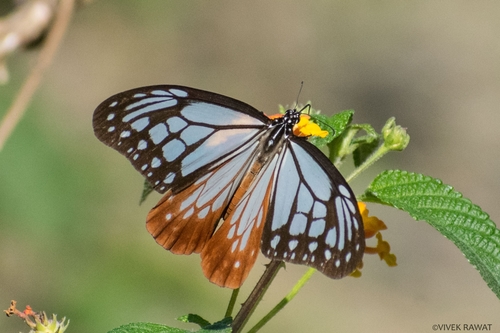
This species, scientifically known as Parantica sita (Kollar, 1844), has elongated wings that closely resemble the wings of the genus Idea. The upperside of its forewing is black or sooty black, marked with a set of bluish-white, nearly transparent markings: a streak starting from the base in interspace 1b, very broad streaks that fill the basal three-quarters of interspace 1 and the entire cell, five very large square-shaped discal spots, two long preapical streaks, three shorter streaks positioned above these, a subterminal series of more or less rounded spots that decrease in size toward the anterior and curve inward opposite the wing apex, and an incomplete subterminal series of smaller spots. The hindwing is chestnut red, with nearly transparent streaks and spots arranged as follows: streaks starting from the base that do not reach the termen in interspaces 1a and 1b, two broad streaks united nearly to their apex in interspace 1, a streak that fills the cell, and beyond the cell a discal series of large inwardly pointed elongated spots, plus incomplete, poorly defined subterminal and terminal series of spots. The underside of the wings matches the upperside in pattern, with markings that are clearer and more fully formed. Antennae are black; the head and thorax are black with white spots; the abdomen ranges from brown to bright ochraceous, and is whitish on its ventral side. Males have a secondary sex-mark of form 2. This species is distributed along the Himalayas and into the Malayan region, with recorded occurrences in Northern Pakistan, Kashmir, northern India, Sikkim, Tibet, China, Taiwan, Korea, Japan, Malaya, Ussuri, Sakhalin, and Indochina.