About Paranthias colonus (Valenciennes, 1846)
Common Name & Body Shape
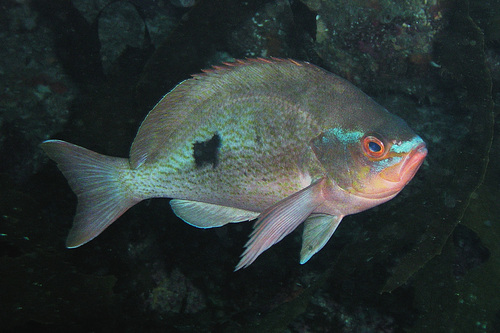
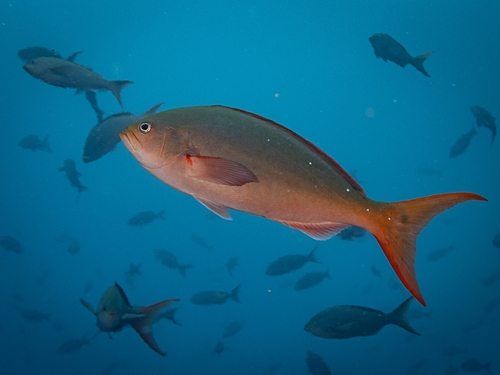
Paranthias colonus, commonly called the Pacific creolefish, has an elongated, fusiform body and a small head with convex profiles on both upper and lower sides.
Gill Raker Count
The first gill arch of this species holds 37 to 44 gill rakers.
Fin Ray Counts
It has IX dorsal rays, 19 to 21 soft dorsal rays; III anal rays, 9 to 11 soft anal rays; and 19 to 23 pectoral rays.
Caudal Fin Structure
Its caudal (tail) fin is strongly concave.
Maximum Size
The maximum recorded total length of the Pacific creolefish is approximately 36 centimeters.
Juvenile Coloration
Juvenile Pacific creolefish are often bright yellow, with five small dark spots on their backs.
Adult Body Coloration
Adult individuals are greenish brown on their dorsal side and reddish on their underside, and carry five white or blue-white spots on the back.
Adult Fin Coloration
All fins of adults are reddish in color.
General Distribution Range
This species is distributed in the Eastern Pacific Ocean, ranging from the Gulf of California south to Peru.
Island Distribution
It can also be found around the Revillagigedo Islands, Galapagos Islands, Clipperton Island, Cocos Island, and Malpelo Island.