About Paralepista flaccida (Sowerby) Vizzini
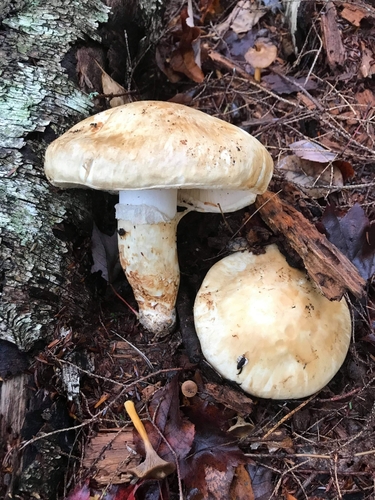
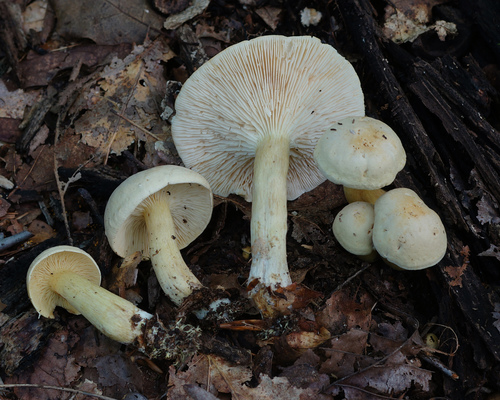
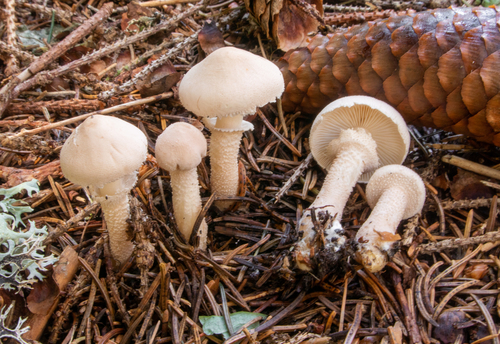
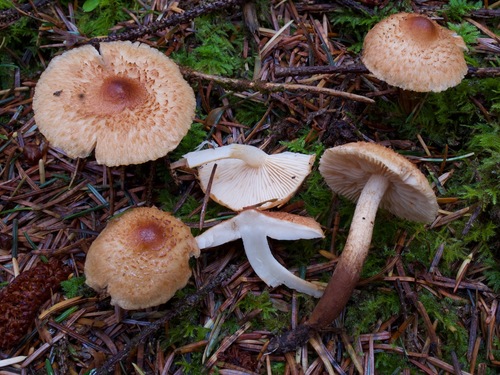
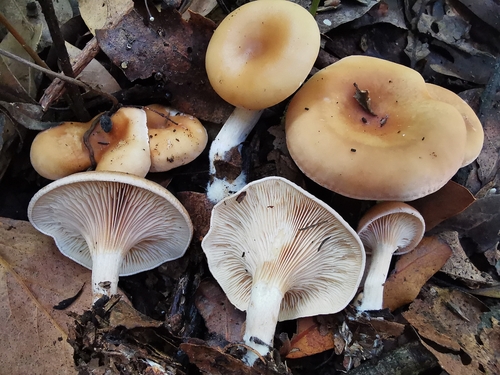
Paralepista flaccida (Sowerby) Vizzini has a convex cap that grows up to 10 centimetres (4 in) wide. As it ages, the cap becomes depressed at the centre or funnel-shaped, and has a variable brownish colour that can be ochraceous, orange or reddish. In the flaccida form, the upper cap surface is matt and silky, and the entire mushroom is flaccid. In the inversa form, the cap surface is shiny and the mushroom is rigid. The gills are decurrent, closely packed, and a lighter shade than the cap. The yellowish stem grows up to 10 cm (4 in) long and 1 cm thick. The flesh is whitish and has a peppery smell, and the spore print is white to cream. Under the microscope, the spores are almost spherical with small spines or warts, and measure about 4.5 μm in diameter. No distinctive cystidia are present, and there is no microscopic difference between the flaccida and inversa forms. This fungus is a saprobe that grows on humus-rich soil, compost or conifer needles from summer to autumn. The flaccida form grows in deciduous woods, while the inversa form grows under conifers. Often numerous mushrooms fruit together, and the species may form fairy rings. It is most frequent and common in Europe, also occurs in the U.S., and has been reported in Mexico and Australia. Regarding uses, mycologist Marcel Bon describes this as a good edible mushroom, but other commentators are less enthusiastic and consider it a poor edible. At least one source does not recommend it for consumption. In regions where the species occurs, care must be taken to avoid confusing it with the similar species Paralepistopsis amoenolens. This mushroom produces multiple chemical defenses. It contains clitolactone, a chlorinated lactone (5-(chloromethyl)-3-methyl-2(5H)-furanone) that acts as a slug antifeedant. It also contains clitocine, a previously undescribed insecticidal nitro nucleoside. An article published in Nature Communications reports that an extract of this mushroom, with the active constituent 2,6-diaminopurine, can correct RNA nonsense mutations, and so may be a candidate to help treat certain genetic diseases.