About Parabuteo unicinctus (Temminck, 1824)
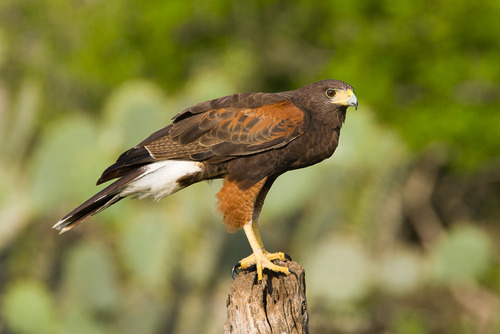
This medium-large hawk, Harris's hawk (Parabuteo unicinctus), is roughly intermediate in size between a peregrine falcon (Falco peregrinus) and a red-tailed hawk (Buteo jamaicensis). Harris's hawks measure 46 to 59 cm (18 to 23 in) in length, and generally have a wingspan of approximately 103 to 120 cm (41 to 47 in). These hawks have dark brownish overall plumage, with characteristic chestnut (reddish) shoulders, wing linings and thighs, tail feathers with both white base and white tip, long yellow legs, and a yellow cere. They show sexual dimorphism, with females being approximately 35% larger than males. In the United States, adult males have an average weight of about 701 g (1.545 lb), ranging from 546 to 850 g (1.204 to 1.874 lb), while adult females average 1,029 g (2.269 lb), with a weight range of 766 to 1,633 g (1.689 to 3.600 lb). The vocalizations of Harris's hawk are very harsh sounds. In the wild, Harris's hawks have a lifespan of 10 to 12 years, while individuals in captivity have been recorded to live up to 25 years. Harris's hawks inhabit sparse woodland, semi-desert, and tree-containing marshes including mangrove swamps in parts of their South American range. They are permanent residents that do not migrate. Scattered larger trees and other landscape features (such as utility poles, woodland edges, standing dead trees, live trees, boulders, and saguaros) provide them with important perches and nest supports. Wild Harris's hawk populations are declining due to habitat loss, but the species has been recorded moving into developed areas under some circumstances.