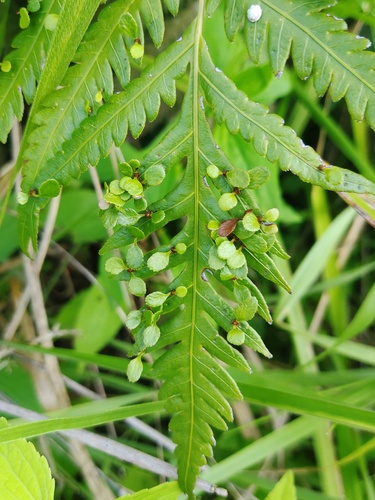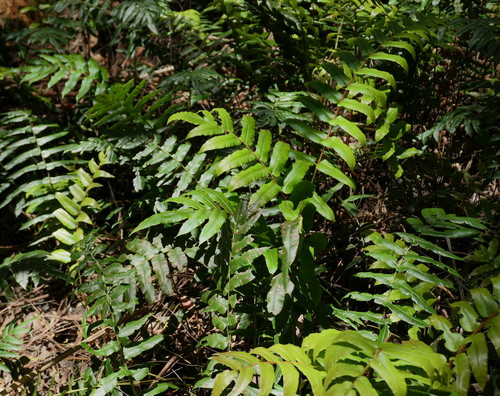
About Parablechnum wattsii (Tindale) Gasper & Salino
Parablechnum wattsii (Tindale) Gasper & Salino, also known by the synonym Blechnum wattsii, is a common terrestrial fern. It grows in rainforest and open forest, and is often found near creeks across much of southeastern Australia, including Victoria, Tasmania (and King Island), South Australia, New South Wales, and Queensland.
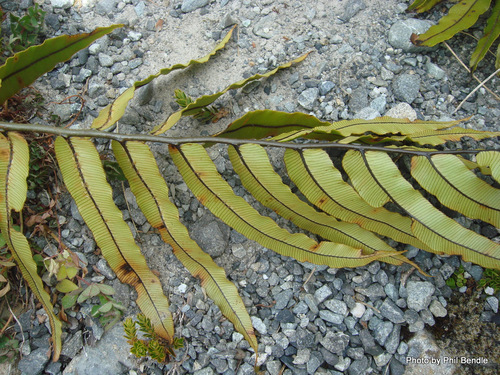
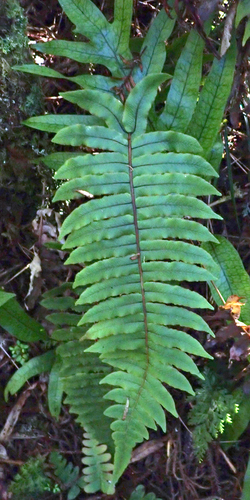
The species' specific epithet wattsii honors William Walter Watts (1856-1920), who was considered an authority on mosses and ferns, and has more than 30 species named after him. This plant has several common names: hard water fern, named for its stiff leathery fronds; leech fern, because forest workers often encounter leeches while working in clusters of these ferns; hard hill fern, named for the fern's growth habit and habitat; and red cabbage fern, because the bronze-pink color of its young fronds resembles cooked red cabbage.
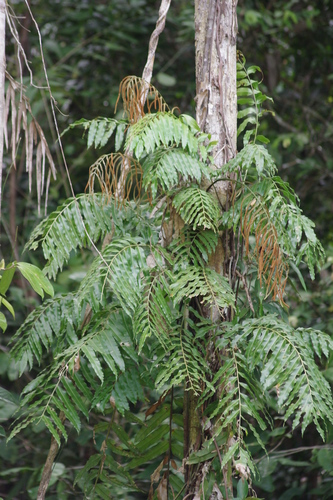
This hard water fern is found in all southeastern Australian states. In Tasmania, it is widespread and abundant, growing from sea level up to 1000 m across a range of vegetation types. It occurs in many rainforests and wet sclerophyll forests, and prefers damp, shaded areas along creek and river beds, on the margins of water courses, and near waterfalls. It grows best in loam or sandy, well-drained soil that is rich in humus.
Parablechnum wattsii follows the typical fern life cycle, with distinct sporophyte and gametophyte stages. A characteristic trait of the Blechnaceae family, which this species belongs to, is the presence of separate fertile and sterile photosynthetic fronds. Fertile fronds produce numerous prolific spores that are easy to collect and propagate into mature plants. It takes roughly 4–6 weeks for the prothallus to form, and an additional 6–12 months for the first true fern frond to develop. Mature plants can also be divided from their root stock, as long as the parent rhizome experiences minimal disturbance. Natural division may also occur through injury to the underground rhizome as the fern ages and its tissue degrades. After propagation, P. wattsii requires moist, sheltered, partially shaded growing conditions.
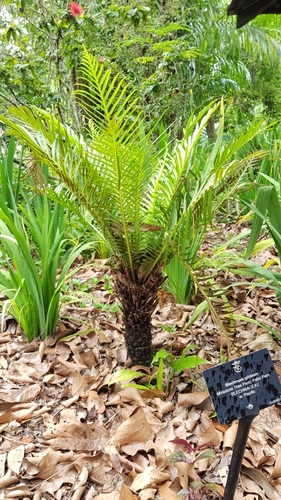
Hard water ferns are propagated for use in large ferneries, alongside shaded water features, and in sheltered gullies. P. wattsii cannot tolerate drying out, so it should only be planted in areas with adequate water availability. Aboriginal Australians use the fern's rhizomes as food, eating them raw or roasted as a source of starch.