About Pappea capensis Eckl. & Zeyh.
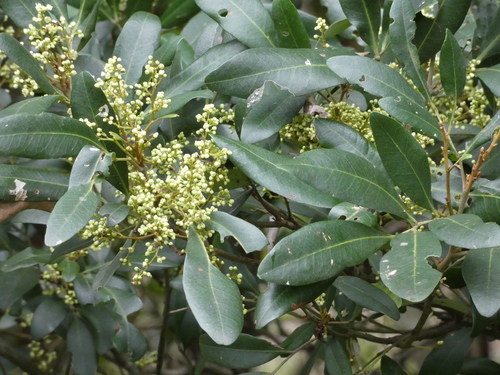
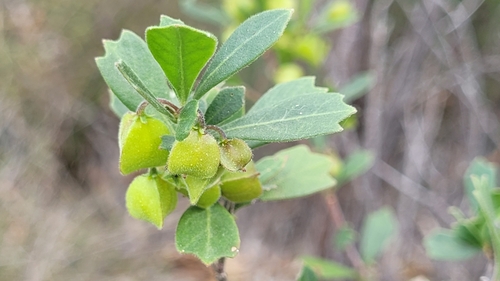
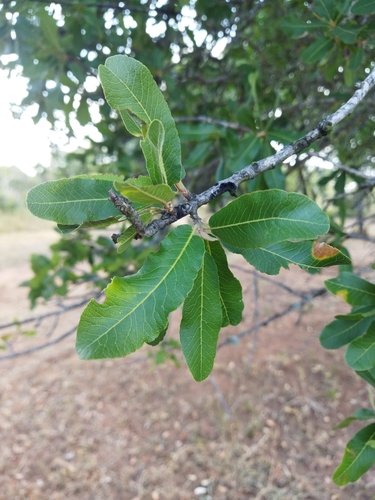
Pappea capensis Eckl. & Zeyh., commonly called the jacket plum, is a long-lived, hardy evergreen small to medium tree that reaches 7–13 metres (23–43 feet) in height. It has alternate, simple, oblong, hard-textured, wavy leaves that are crowded at the ends of branches. Leaf margins change from sharply toothed on young growth to almost smooth on mature leaves. Greenish flowers are borne on catkins in the axils of the leaves. This species is monoecious, with flowers going through a distinct male phase followed by an equally distinct female phase. Flowering occurs from September to May, and fruit develops from February to July. The tree forms a dense crown that is popular with nesting birds, as it provides good nesting sites. Its fruit is a furry green capsule 10–15 millimetres (0.4–0.6 inches) in diameter, which splits open to reveal orange-red flesh containing a single black seed. The fleshy fruit is eaten by birds, animals, and humans, and the jacket plum is related to the litchi. This species is widespread in southern Africa, ranging from the Northern Cape through the drier Karoo, Eastern Cape, and KwaZulu-Natal, into Mozambique, Zimbabwe, and northwards to Botswana and Zambia. It grows in bushveld, riverine thicket, wooded grassland, rocky outcrops in grassland, and scrub veld, and is often found growing on termite mounds. In its ecology, fruit is eaten by various frugivorous birds and animals, which distribute the seeds in their droppings. Leaves are browsed by game including elephant, giraffe, kudu, nyala, bushbuck, and grey duiker, as well as domestic stock animals. The jacket plum is recorded as a larval food source for these southern African Lepidoptera: Common hairtail butterfly (Anthene definita), Brown playboy butterfly (Virachola antalus), Pearlspotted charaxes (Charaxes jahlusa), Gold-banded forester (Euphaedra neophron), and Reticulate bagnest (Anaphe reticulata). Its sweetly scented flowers attract a wide variety of insects and birds. Seeds are parasitised by a small, bright red bug (Leptocoris hexophtalma), which sucks oil from the seeds on the ground below the tree. The delicious, very juicy fruit has a tart flavour, and is used to make preserve, jelly, vinegar, and an alcoholic drink. Leaves, bark, and oil extracted from the seed are used medicinally to treat baldness, ringworm, nosebleeds, chest complaints, eye infections, and venereal disease. Bark is also used in protective charms that are sprinkled on the ground. Some research has found that the leaves are very effective in killing snails. Infusions of the bark are also used by Kenyan Maasai warriors to gain courage, as an aphrodisiac, and as a blood-strengthening tonic. The root is used orally, as an enema, and as a purgative for cattle. The tree is an important source of herbal medicine. Its wood is hard, light brown with a reddish tint, tough, and heavy, with a twisted grain, and there is little difference between the heartwood and the sapwood. Stems seldom grow to a significant girth, so they do not yield much usable wood.